Showing posts with label laugh. Show all posts

Friday, March 14, 2014

Chapter One, Part 3: How To Describe My Dad

One thing that some people who knew my dad may not know about him is that he was very competitive, mostly with himself. He regularly set goals for himself in different areas of his life, probably most often in the sport of running.  His objective for events varied from race to race, whether it was to be among the top finishers, to run the race in a certain time, or to complete a race that was unlike one he had done before, like an ultra-marathon, an adventure race, or a triathlon.

Even with an objective in mind, though, Dad always tried to help other people who were also competing in the races in which he ran.  He often cheered people on in the middle of a race while he was running.  He thoroughly appreciated the spirit of competition and admired people who overcame adversity and challenges to rise to the top, especially when their success wasn’t expected.  On more than one occasion, Dad won a trophy or a medal in a race and then gave it to someone else who had competed in the race but who hadn’t won, often a child who had finished a race for the first time ever.


When I was a teenager, Dad took a couple of guys from my high school and me to a state park in Mississippi to compete in a small-town road race.  We left early on a Saturday morning, and, as we drove the last mile or so to the starting line, we saw a teenaged boy walking along the side of the road in basketball shorts, walking barefooted and carrying spiked track shoes.  The guys in the car and I laughed when we passed the boy because he seemed so poorly prepared for a race that was about to be run on a paved road.  Dad didn’t laugh, though; instead, he said, “You never know who’ll get the last laugh.”  We found out how true that was after the race when we found out that the boy had finished in second place overall, running on Dad’s heels with his spikes clicking on the pavement for the entire 5-mile race. 

From the time I started running, Dad often found out about races that were coming up in the area and registered me as well as himself in those events.  He and I ran in a total of roughly 100 events together over the years. One of his routines before a race was to size up the competition for himself and for me; in my competitive days, he gave me an honest assessment of how he thought I would fair in the field and if it seemed like I had “a shot at placing,” or finishing in the top three spots overall or in my age division.  Whenever possible, we drove the course ahead of time, with him pointing out any big hills or sharp turns along the way because, as he always said, those were the places to “make a move” to pass other runners just ahead on the route. In every race, he finished before me and then ran back to find me on the course, to cheer me on and give me advice, especially if he saw me struggling.  Once he had seen that I was ok, he would run ahead to the finish line to wait there for me to make it in. 


One thing that I think my dad learned from me after I had finished running competitively in high school is that there is a sense of pride and accomplishment that can come from just finishing a race, if that is one’s objective.  When I left home to go to college after high school, I went from running six days a week on a strict training program to running when I felt like it and when I could fit it into my schedule, a pattern which continued into my adulthood.  Dad told me many times that a runner has to “make time to run,” but he saw my priorities change and understood that running did not carry the same weight for me as it did for him. 

When I was in training to run my first half-marathon many years ago, I asked my dad if he would go on a long run with me so I could work on pacing before the race.  On the morning of the run, my brother-in-law drove Dad and me out into the country and dropped us off ten miles out of town so we could run back on mostly farm roads with limited traffic.  

I remember that I was wearing a running shirt that day that said "Run the mile you're in." After we'd gotten out of the car and started on the run, Dad looked at my shirt and said, "I don't get it - what else would you do besides running the mile you're in?"  That turned the conversation into a Who's On First-type of exchange that last for several minutes, until I said, "I think it's referring to the way that a person can choose to be grateful for what he has instead of thinking that the grass is always greener or that someone else is luckier than he is."  He thought for a second and then said, "I just don't get why somebody wouldn't do that, because, really, if you think you're lucky, then you are!"  

And that, in essence, was my dad.

Monday, April 29, 2013

The Hitchhiker, Part 1: The Gift of the Story


As I have learned since my dad went on ahead, one of the greatest gifts that can be given to someone in grief is talking to him or her about their loved one: telling a story that involves the person who has died, sharing something you remember about that person, or talking about a quality that person had or a deed he did that you appreciated can be a priceless treasure.  It doesn't have to be a significant account; sometimes something funny or unique that person did is just what the person who is grieving needs to hear.

Not long after my dad died, my mom, my husband, and I went to the Mid-South Grain Association meeting in New Orleans, or simply "Mid-South," as my dad called it in general conversation.  Dad was in charge of organizing the convention there every February, and we went after he died to represent him in a way.  My mom kept up with the administrative duties that she had assisted Dad with for many years, but, as I came to find out, it was as helpful for us to be there amongst many people who had known Dad for years - some for decades - as it was for them to have Mom filling in at the registration desk.

The highlight of the trip for me was listening to one of my dad's long-time friends and previous coworker talk about some of Dad's antics from "back in the day."  Some of the tales I had heard before, mostly from Dad himself, but others I had never heard, and I felt comforted by all of them; it felt almost as if I was getting a piece of my dad back for just a little while.

Like a lot of people, Dad was a work hard/play hard kind of guy.   But the thing that I think made him unique in that area - at least from what I have gathered from seeing him interact with people professionally and from listening to what others have said about him in a business context over the years - is that he was often able to make the work environment fun for himself and for others.  For starters, he never hesitated to laugh at himself, and his interest in everyone around him was genuine.  Never did he miss an opportunity to say hello to or to compliment or express interest in someone else; the way he assumed that pretty much everybody had good intentions somehow seemed to result in that becoming a self-fulfilling prophecy.  He delighted in clowning around when time and the situation allowed; I don't know that he learned about the benefits of fostering a positive work environment in a formal setting, but he certainly applied the principles all the same and always seemed very popular with his employees because of it.

"Cotton Row" on Front Street in Memphis, Tennessee

Here's the story that my dad's friend told us from back in the early 70's, when my dad worked at a company with an office that was located in downtown Memphis:

One Friday, some of Dad's clients had come to Memphis from out of state, and he was in charge of entertaining them that night.  My mom had driven with my sisters and me to her parents' in Nashville for the weekend, and Dad was planning to drive to meet us there late that night after he had taken the customers out on the town.  He worked until closing time and then met them at a restaurant down the street from his office.  As the story goes, the dinner turned into more of a party than Dad had expected, and when it was over he returned to the office since he had parked nearby.  Evidently, he was trying to ward off the headache he thought he'd be getting the next morning and so he walked over to his desk to get to his bottle of aspirin.  Unfortunately, though, the floors were in the process of being redone, and Dad left footprints on the adhesive backing that had been laid down in preparation for the tile that was going to be installed the next day.  Apparently there was much laughter the next morning and later some friendly ribbing about the fact that everyone could tell who the culprit had been since the tracks lead straight to his desk, where several aspirin tablets were spilled on the desk, and then back to the exit door.  


As Dad himself later told the story to his friends and coworkers, after he'd gotten into his car and then started driving on the interstate headed towards Nashville, he realized that he'd had too much to drink to be driving.  As luck would have it, soon after that he saw a hitchhiker on the side of the road. Necessity being the mother of invention (and of innovation), Dad pulled over and rolled down the passenger-side window to ask the guy if he could drive and where he was trying to go.  "Sure, I can drive," the guy said, and then he added, "I'm hoping to get to Nashville tonight."


"Well, get in, then," Dad told him, probably smiling from ear to ear and thinking he had struck gold. "I'll be asleep in the back; wake me up when we get there!"


I doubt he told my mom about the details of that trip for quite some time after it happened, and it wasn't until after his death that my sisters and I heard the story.  I could picture it happening though, and hearing the tale was a much-appreciated gift, one that I will always treasure.  And it wasn't Dad's last interaction with a hitchhiker either, ...

To be continued ... 

Wednesday, January 16, 2013

On Being Lazy

My dad never picked favorites - whenever he was asked to do so he would flat-out refuse.  He always said that designating a favorite would just make one seem better than another and that there was no point in that. -  After years of hearing him say that, I knew better than to ever ask him to pick a favorite of one over another, but once during one of our middle of the night talks while he was sick, I asked him what he thought the worst quality in a person is. His reply: being lazy. I had to laugh, because that made me think about when remote controls first came out on the market for TV's and he thought they were ridiculous. "It's lazy enough just sitting there watching TV," he'd said, "but I can't imagine why someone couldn't get up off the couch every once in awhile to change the channel or adjust the volume!!"  When he said being lazy was the worst trait a person could possess, though, just out of curiosity I asked him if he thought it was worse to be lazy than to be a liar or a thief. He thought for a minute and then, with a half-smile of his face and in a tone that left me wondering about whether or not he was kidding, he said, "Well, at least when a person does those things, he's putting some effort into it.


He also commented a lot over the years about how crazy (and by that I think he meant lazy) he thought it was when someone would drive around a parking lot in search of the perfect parking spot rather than just parking in the first available place they encountered and walking.  It just wasn't something that he could make sense of, I guess, and he often pointed out that the people who do it at the gym are the worst

I think Dad's distaste for laziness - which he thought of as a lack of activity or a lack of effort - made it harder for him to tolerate his physical condition and the challenges that came along with it when he was sick.  I'm sure he didn't like having to be helped or having to wait for help doing things, and it didn't surprise anyone who knew him that he wanted a plan in place so he could "do something" every day to work towards getting better.  When his health declined instead of improving as we'd been told it would with the treatment, though, I started to notice that he didn't comment nearly as much about wanting to have goals for himself or about needing help to do basic things. It was as if he had somehow resigned himself to his condition. I thought at the time that maybe he was just biding his time until he could be independent again.  Now I wonder if he somehow saw letting us help him as trying to help us


Saturday, January 5, 2013

Two Years Out

Have you ever run into someone whom you haven't seen in awhile and noticed that something about that person that you can't put your finger on has changed?  Maybe it was something so indistinguishable, so subtle, that you have even wondered if it was just your imagination, but still you felt that something was different about that person than it was in the past.  That's what grief feels like for me at this point.  It has changed over the course of the two years since my dad died, but it's hard to say exactly how.  Or maybe I have changed in how I address the grief and in how I cope.  One thing is for sure, though: it's still looming; it's not any less of a threat except for the fact that I guess I have learned a little bit about how to manage it.  

Part of me is shocked and even a little bit impressed (surprised?) that we've made it to the two year point after my dad went on ahead.  We've done it; we've helped each other through it and we've survived it, so far.  Some days, though, it feels like running the third lap of a four-lap mile around the track, which for me was always the most painful because I knew that I had to give it my all in that part of the race but I was also aware that there was so much work left to be done even after that lap had been completed.  Part of me is so shocked and so saddened by that fact that we're already at the two-year mark that just the thought that it has been that long since I've seen him immediately brings tears to my eyes.  Two years.  How did that happen?


I had a dream about my dad a couple of nights ago, and in it he was sick and he kept asking me, "How did we get here?"  At first, I thought he meant that he wanted to know how we had arrived in the physical location where we were, which was, oddly, sitting on a bench in a park that was not familiar to me (and certainly it wasn't somewhere that I went with him while he was sick), but then it dawned on me that he was asking how we had gotten to that exact point in time.  And then in the dream I turned to him on the bench with tears in my eyes and I said, "We got here because of your strength, your courage, your toughness, your determination, and your love, and we will never forget that."  I knew he want to know how he had gotten cancer and how it had gotten so bad so quickly, but no one knew the answers to those questions.  What I did know in the dream - what I wanted to convey to him - and what I do know in real life is that my dad is the reason that my family and I have had the fortitude not to crumble in the midst of the biggest challenge of our lives; time and time again, we have held him up as an example of how to face the pain of our grief, how to cope with the sadness and the anger that threaten to overtake the joy and the promise of hope for a better tomorrow, and how to look for the good on even the roughest of days.  That's how we have gotten here; that's how we've made it through these two years since he had to go on ahead.


But of course knowing that doesn't make me miss him any less; if anything, the passage of time makes me miss him more!

It's not just that today marks the two year anniversary of my dad's death that brings him to mind; I miss him all the time.

I miss how he and I could laugh over the craziest things, sometimes things we knew were ridiculous or even dumb but we thought they were funny anyway. 

About ten years ago, Dad and I drove from my house to the small town in Alabama where my grandmother lived to pick her up and bring her back to my house so she wouldn't be alone on Christmas.  It was about a 7-hour long drive each way, and we had a great time talking and laughing along the way, just the two of us on the way there and then with Grandmom on the way back.  At one point en route to her house, we stopped at a gas station that happened to be in a rough neighborhood; we both got a big fountain drink inside the convenience store and then got back into the car.  As Dad pulled out of the parking lot and turned onto the street, we heard a loud ricocheting type of noise on the back window of the car.  Each of us instinctively ducked our head as Dad quickly pulled the car over onto the side of the road so we could see what had made the noise; we both thought we had been caught in a crossfire that had shattered the glass on the back window.  When we'd had a few seconds to process things, though, we realized that the sound had come from the ice from the drinks that had spilled as we'd turned the corner after both of us had set our cups on the roof and had forgotten them there as we got back in the car.  A good laugh ensued, and we headed out onto the road again.


I miss the inside jokes and the memories we shared from running together.  One thing we used to talk about in that vein was our strategy of "rounding up" our run time ("If you say you'll be out running for 40-45 minutes, you can go for almost an hour before anybody notices," Dad had advised me many times throughout the years when I complained about not having as much time as I liked to have to run.  Prior to the time when he began training for the Ironman triathlon, his fitness goal from age 55-65 was to work out for an hour a day, at least 5 days per week.)  

I miss the exuberant way he marked his place in books, by folding half of the page down.  I was reminded of this just a couple of weeks ago when I was going through some books to see which ones could be donated to charity and I came across a book that he had handed down to me a few years ago, complete with folded down pages marking the places where he had taken a break from reading along the way.

I miss the way he took joy in everyday tasks and, in doing so, he made them fun for those around him.  This included lots of things he did to entertain me on long runs - things like singing as he ran and alternately bounced and caught a tennis ball to the beat of a song, like taking me on different running routes that he had scouted out in advance to make each one an adventure, and like coming up with unusual training techniques for the two of us like running up and down the steps on the outside of a grain storage bin for a certain amount of time (which he then challenged me to try to improve on when we did it again the next week).  

We ran up and down steps like these
as one of our training routines.
There were lots of non-running tasks that Dad made fun, too, though.  One thing I was thinking about recently was what he called "Laundry Parties."  When I was a teenager, Dad, as the person in our house who did most of the laundry, had trouble discerning whose clothes were whose between my mom's, my sisters', and mine, and so he often brought laundry baskets full of clean clothes into the den, dumped them on the couch, and announced to my sisters and me that we had to help fold them.  "It'll be fun!" he'd say. "It's a Laundry Party!" and, although we usually groaned and complained about having to help, he always joked around and made a usually boring task fun.  

I miss the way he hugged, which was often more back patting than anything else.  Somehow his technique always seemed to instill confidence in me, as if the back-patting was literally him patting me on the back to let me know he thought I'd done something right.

I miss the funny random emails and phone calls from him, sometimes about something so out of the blue that just his question or comment made me laugh out loud.  Once he called to ask me how to spell "coulotte" (pronounced "coo-lot" - this is a style of women's pants also known as a split skirt, in case you didn't know).  I spelled it for him, he thanked me, and then, obviously in the middle of a thought, he hung up.  I had to ask him later why he needed to know: he had been writing a memo to employees in his office about what was and what wasn't acceptable attire for Casual Fridays.

I miss the funny rules he made up for some things, like "I never drink beer that I can see through," a rule he imposed several years back when he discovered that he had a penchant for dark beer, despite the fact that he had been drinking lite beer for decades before that.

I miss the smell of Brut on him, so much that I sometimes break out a bottle of it that I have stashed in my bathroom just to take a whiff of it.  It's comforting in that context; it's disturbing and sad when I smell it on someone else in passing, as if that intrudes on the comfort of it in my memories from when he wore it.  

I miss the way he bounced on the balls of his feet when he walked.  I miss his competitiveness, which he carried on with himself as much as anyone else, and I miss his pride.  I miss the way he could (and usually did) talk to anyone who crossed his path.

I miss the way he lost certain things, like his wallet, so often that he tended not to worry about it whenever he did; like he did with a lot of other things, he didn't worry because he thought worrying was a waste of time and he just believed that everything would be ok.


I miss having him ask me about my job and how things were with my husband and the kids; I really miss how he used to listen to what I said in response and then how he would sometimes sigh as if he felt exhausted on my behalf and then say, "I don't know how you do it all!" with so much pride and admiration in his voice that it soothed me and made me proud, even when I'd felt like I had been struggling before then.

I miss his no-nonsense attitude and advice, the same kind he gave me when I called to tell him that I'd been offered my first job as an occupational therapist after I'd graduated from college.  I told him what the salary would be and that I thought it would be a great place to gain experience, and then I said that I had told the human resources department that I would get back to them about my decision.  Without missing a beat, he said, "Haven't you been wanting to work at a children's hospital like that for many years?"  I told him that I had, and he said,  "Well, then, what are you waiting for?" was the advice I got in return, in response to which I hung up with him and made the call to accept the job. 

I don't think Dad always recognized the value that other people found in the advice that he gave out, though.  Late one night when he was in rehab and he, as usual, couldn't sleep, we were talking about the schedule for the next day and I reminded him that I was leaving to drive back home as soon as my mom got back to stay with him the next morning.  "Be really careful driving back," he told me, and then he said, "Be sure not to stop for gas in the valley on the way back; it could be dangerous there and cell phone coverage isn't good."  He paused and added, "But I'm sure you can take care of yourself."

Before I could say anything in response, he commented, "Sometimes I worry that any advice I've given you hasn't been about the important things."

"What do you mean, Dad?" I asked him. "You've given us good advice!" to which he responded, "All I can remember telling you is stuff like always keep a towel in the trunk of your car and put some toilet paper in the waistband of your shorts when you go for a run in the woods."  It was true; he had told me both of those things many times throughout my life, and, truth be told, I always did both of them (and still do).  But, of course, that wasn't the bulk of the advice he had given to me over the years, and I wanted to be sure he realized that.  "You've taught me a lot more than that," I told him, but the only answer I got was the sound of his rhythmic snoring.  After tossing and turning and chatting for the majority of the night, he had, at last, fallen asleep.


I miss the lists of "suggestions" he emailed to us before his birthday, Father's Day, and Christmas.  To me, he was always the easiest person to buy a gift for, not just because of the list but because he had such distinct hobbies and because he would often just "make do" with whatever he already had instead of buying the latest and greatest accessories and gadgets for himself, leaving it open for us to give those things to him later if we wanted.

Once when we were running together during the time that I was preparing for a marathon, I told him that I had gotten some new gear to help me with the training and that I had estimated that I had several hundred dollars of equipment on me every time I went out the door to run.  He actually stopped in the road and said, "Are you serious?"  Yes, I told him, but that included my high-tech clothes, my shoes, my GPS-enabled watch, my heart-rate monitor, my sunglasses, and my iPod.  "That's crazy!" he said, incredulous.  He started running again but insisted that we go back by the house so that I could "ditch the extras." "That way we can really run just to run," he said.  And that's what we did.  How I miss being able to do that with him, and to talk about anything or nothing along the way.  Damn.


Thursday, November 15, 2012

Living Strong


We've all heard the expression "Live Strong," especially in the context of fighting cancer. 

Since my dad's diagnosis, though, I've come to view the meaning of this command in a different light, and I see now that it’s not just for the people who have been diagnosed with cancer, but also for those who are caring for them - and even beyond that to those who are left behind to grieve.

By all accounts, my dad "lived strong" during the ten weeks he was battling for his life against the brutal brain cancer that took first his independence and shortly thereafter his life.  He literally fought with all his might until his very last breath.  

I've heard it said that people die as they have lived, and, in regards to being courageous and strong, definitely that was true for my dad.  And, as for my family, I think we've "lived strong" too, working as a team throughout his illness and since then.

In many ways, it's been the "since then" part of this whole thing that I've found to be much harder, but, to honor my dad and the rest of my family, "living strong" has been and continues to be my goal.  

Sometimes I worry that I'm not being strong enough now, though.  


When I was a teenager, I had a t-shirt that had big lettering at the top of it on the front that said "Trackster's Excuse Shirt." Underneath that were listed dozens of excuses that people often used not to run on any given day, things like, "I'm sore from yesterday's workout," "I think I'm coming down with a cold," "I had to work late," and even "It's too cold outside" and "It's too hot outside."  I loved that shirt, and I wore it often.  Dad and I used to make up additional excuses that we thought should also have been listed on the shirt and laugh; there were many days when I didn't especially feel like running but I did it anyway because the shirt helped me to realize that whatever excuse I had was just that - an excuse.  I remember the day I got braces on my teeth; when Dad got home from work that afternoon after I'd gotten home from the orthodontist, he told me to get my running gear on, and I protested, claiming my teeth were too sore to run.  "Oh, really?" Dad asked with a smile on his face. "Should we put that on the excuse shirt too?" Of course, I laughed and then suited up so we could head out the door to run as planned.

Lately I've been thinking that maybe I need a shirt like that, one that lists all the reasons excuses I so easily come up with these days for not running (or for anything else, for that matter): "I didn't sleep well last night;" "I miss my dad too much;" "I'm grieving;" "I'm too busy at work," etc.  

There's no good reason, only endless excuses, and yet I still can't seem to find the drive to do it anymore.  A few years ago my dad gave me a big magnet to put on the back of my car that says "Runner Girl."  I took it off my car more than a year ago; it just felt so disingenuous, and seeing it every time I walked around to the back of my car made me sad.  Sad that I wasn't running, sad that my dad couldn't be.

That's just one of the things that I used to do that I don't anymore, one of the changes that I don't know the reason behind and that I don't like.  I'm honestly not sure if I should grit my teeth and try harder to live strong or if I should just look at it as a temporary thing that I have to go through and go with it for now; I know that some of this is just part of the process - and that some of it is out of my control.

From the time when I was about 12 years old, I always volunteered to pack the car the night before we went on a family road trip.  I liked being the one who knew where everything we might need during the course of the trip was in the car, from a deck of cards to snacks to a box of tissues and a map. 

I think one of the hardest things about dealing with a terminal diagnosis and the grief after the death of a loved one is having the realization that there is no control to be had and that there is no getting prepared for some things in life.  In essence, there is no packing the car the night before in Real Life.


In grief, you spend a lot of time focusing on, well, you.  Grief tends to make us shut out other things at times, not out of self-centeredness but out of necessity.   It is a rough road, one riddled with obstacles, but one with learning and growing and - with time and effort and luck instead of excuses - living strong, to the best of our ability.  We just have to get through it, in our own way.


Tuesday, October 30, 2012

Speeding


Last week, I was issued the first speeding ticket I've gotten in almost 19 years.  Seeing the blue lights in my rearview mirror, I pulled over onto the shoulder of the road and rolled down my window.  As I sat there waiting for the officer to walk over, a vivid memory of my dad came flooding back to me; I would venture to guess it isn't too often that a person who is about to be ticketed for speeding has a smile on their face and a sparkle of tears of joy in their eyes as they hand over their license and registration as I did, but having the flash of the good memory made it worth the price of the ticket to me.

As I've mentioned, my dad hated to be late to anything. While I was growing up, that desire to be not just on-time but EARLY often translated into driving above the speed limit for him, especially considering there were four females that he had to get out the door and into the car before we even got on the road.  As a result, he got lots of speeding tickets over the years, especially on long distance trips, which we took as a family pretty often.  

It wasn't as if he didn't try not to get speeding tickets: I remember when those label makers first came out on the market and Dad was so excited to buy one.  He used that thing to make sticky labels not so much for organizing and identifying things as I'm pretty sure it was intended to be used but much more for creating reminder notes for himself, including several "Don't speed" messages that he put on the dashboard of the car.  


I also remember him putting sticky notes up in the car to keep an ongoing tally of how many "points" he had from speeding tickets; he was always worried that he would lose track and go over the limit, which would have resulted in a suspension of his driver's license. 

The other thing he did to try to keep from getting too many speeding tickets was to buy a radar detector, or, as we called it, a Fuzz Buster.  That worked pretty well for awhile, until the police caught on to what people were doing and started just pulsing their radar guns at cars to keep drivers from getting a warning; that presented a problem for Dad, especially when we had to drive through states with "no radar detector" laws.  Dad couldn't keep track of which states ticketed drivers for that and which didn't, and so he just used his anyway anywhere we went and then, whenever he got zapped by a pulsing radar gun, he quickly unplugged the Fuzz Buster and threw it to us kids in the back seat of the car so we could get in on the conspiracy and hide it for him, which we thought was great fun. 

Another thing I remember about Dad's speedy driving habit is how much he hated it when the Sammy Hagar song "I Can't Drive 55" came out, which I think was in the mid-80's when the national speed limit was changed to a maximum of 55 MPH, something that Dad thought was very un-American.  


In the times when he did get pulled over, he was always a good sport about it, typical of his "win some/lose some" mentality.  In fact, I guess he thought the officer that was pulling him over deserved a laugh because he often tried to joke with him or her by doing things like rolling down his window and then acting like he was placing an order at a fast-food drive thru window: "I'll have a hamburger, an order of fries, and a large Diet Coke," he'd say, sometimes getting a laugh from the cop and other times getting a really mean scowl, which we later had fun imitating amongst ourselves in the backseat after Dad had taken his ticket and sped off again.


Thursday, July 19, 2012

Casting Our Votes


In my family, we have a running joke about voting that came from my dad, who always told other family members how he was planning to vote and then said "Don't vote against me!" (jokingly - I think). He always told my mom in particular not to vote opposite of however he said he was planning to vote; "We'll just cancel each other out if you do!" he quipped before every election.  (I'm pretty sure Mom still voted her own way anyway!)

I remember the first time I was going to vote after I'd turned 18; Dad, of course, sent me off to the polls with an encouraging pat on the back and a "Don't vote against me!" directive.  I think he was glad when first I and later both of my younger sisters were finally old enough to vote because he thought it upped his odds for having one person in the family vote his way, as he put it.

This week, his words came back to me - in fact, they popped right out of my mouth - as my 18 year-old daughter and I stepped away from our respective voting machines after we'd voted in the state primary election.  I got several glares from the poll workers (or whatever they're called) and others in the vicinity; I guess they thought I was seriously trying to influence her vote.  She recognized the source of the quote right away; she'd heard me tell about how my dad used to say those very words every time before an election, and we got a good laugh out of the whole thing.

Gramps would be SO PROUD! 
There really is always something there to remind me, and for that I am so very grateful.

Sunday, August 7, 2011

The Flag Flies

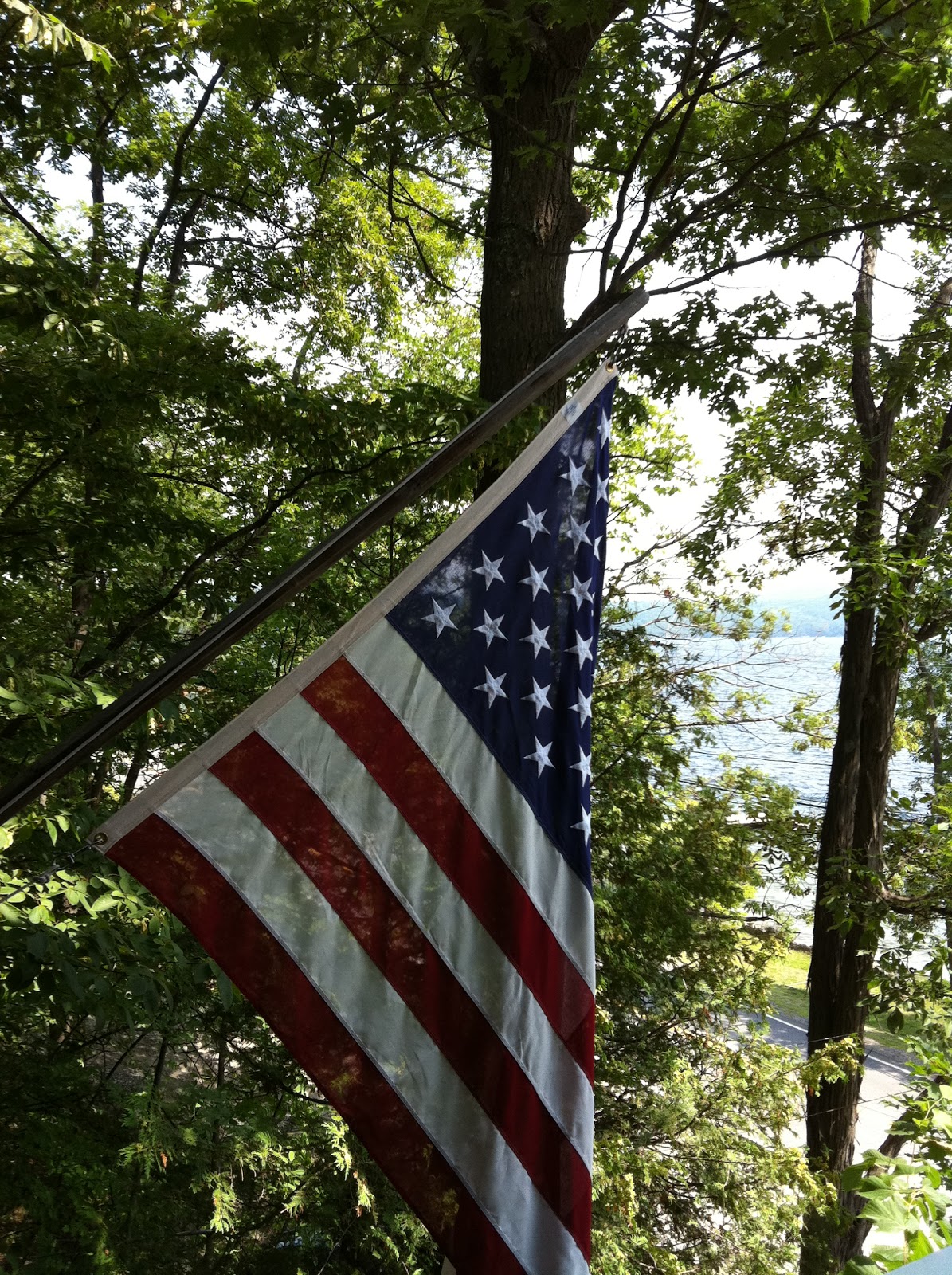
At my dad’s funeral, my mom was presented with an American flag as part of the military funeral service.  Afterwards, she said she wanted the flag to be flown somewhere that had significance to Dad and to the rest of the family.  It didn’t take long for her to think of the perfect place:  at my brother-in-law’s family’s lake house in Hague, New York.

This past week, my mom traveled with my sister’s family to that location, and now, in memory of Dad and in honor of all the memories that we have there with him, the flag flies, near the front porch of the house, nestled in the trees, overlooking Lake George, in one of Dad’s favorite places in the world.


This house holds many good memories for my family.  Traveling there has provided us not only with opportunities to spend time together under the same roof as an extended family but also to do some things we might not have ever had the chance to do otherwise.


Several years ago when we went there, we went tubing on the Hudson River.  Last summer, we attempted the Adirondack Extreme Adventure Course, a very challenging obstacle course of ropes, suspended bridges, rope swings, and ziplines, all nestled high in the trees. 

These pursuits were fun, exciting, and, most of all, full of memories for all of us.  But the things we loved the best were those we did at Lake George every time we went there.  We always boated to a tiny secluded island in the middle of the lake and cooked out.  After supper every year, Dad and anyone else who dared to join in swam to a neighboring island. 


 Dad also challenged anyone in the group to complete the 2-mile swim across the lake each year.  He looked forward to this swim all year long and was so happy to have another notch in his belt by completing it each time. 


 Dad and whoever else was up for it also ran on the trails in the area.  Dad, of course, literally left the rest of us in the dust on those runs, and loved every minute of it.

But, as much of a thrill as Dad got from his athletic pursuits at Lake George, he also thoroughly enjoyed relaxing there and several times commented that he felt it was one of the most peaceful places on Earth.


He loved hanging out down on the dock with Mom and the rest of the family, soaking up the sun and bantering with us about whether or not the water was too cold to jump in.


The very best part of our time there together, though, in my opinion, was when we were just hanging out together in the house and on the porch.  We played board games and card games, took turns cooking and serving meals, talked about memories in the past and our plans for the future, and laughed and laughed. 

 
On more than one occasion, Dad was the catalyst for the hysterics that erupted there.  His son-in-laws amused themselves every time we got together by plotting to find a time when Dad was unsuspecting to dump ice water on him; he was a good sport about it every time. 

 
Dad always liked to try to keep up with slang and colloquialisms that were being used by the younger generations; the problem with that, though, was that he often only got the expressions half-right, if even that.  Last summer, he heard us talking about the way that some words could be intentionally substituted for a not-so-appropriate phrase as a kind of decoy.  My sister gave him some examples to demonstrate the effect:  “Mother-Father!” “Shut the front door!” and “Son of a business man!”  Dad thought these were hilarious, and, in an effort to be “with it,” he said he was going to try to start using these expressions sometimes too. 

The last night we were there, Dad decided to go to bed before the rest of the adults, and, as he walked off towards the bedroom, he left us with his attempt at hipness by saying, “Mother Father – shave your legs!”


Wednesday, July 13, 2011

Getting The Last Word In


Although my family and I will always remember so much of what happened during the time between October and January, I don’t want the focus of our memories to be from when Dad was sick.  He was so full of energy, humor, and adventure.  He always felt lucky and had such a positive outlook, and even though we miss him so much, we should try to follow his example, even and maybe especially when the going gets tough. 

The last night before Dad came home, my sister Jennifer and I spent the night with him in his hospital room.  It was very late, and he told us he was tired and was ready to go to sleep.  He said, “Night, night,” and we both responded by telling him good night.   Then he said, “OK, good night” and we said good night.  This went on for several exchanges until finally I said goodnight and he said “Shhhh! Quit saying that!” and we figured out that he wanted to get the last word in. 


So to give Dad the last word since he can’t be here to comment, here are five things I know he would want to say:

*Always try your best to laugh, especially at yourself.

*Don’t waste time thinking too much about something or worrying when you can just do it – set a goal and give it your full effort, or, as Dad liked to say, “Hit it!”

*Find something that you love to do and share it with others.

*When you make a commitment, stick to it.

*Live life to the fullest – don’t wait to do the things that are on your Bucket List – spend as much time as you can with people you love and doing the things you love.


Thanks, Dad, for the late-night talks, the laughs, the lessons, the support, the love, and the perspective.

Saturday, June 25, 2011

The Spirit – Not the Spirit of Competition


I’ve been thinking a lot about competitiveness and its place in my life lately.

Dad was very competitive, unless it was at the expense of someone else.  He always set goals for himself for running, whether it was to be among the top finishers, to run the race in a certain time, or to complete a race that was unlike one he had done before, like an ultra-marathon. 

Even with an objective in mind, though, Dad always tried to help other people who were also competing.  He often cheered people on in the middle of a race while he was running.  He always appreciated the spirit of competition and admired people who overcame adversity and challenges to rise to the top, especially when their success wasn’t expected.  On more than one occasion, Dad won a trophy or a medal in a race and then gave it to someone else who had competed in the race but who hadn’t won, often a child who had finished a race for the first time ever.


When I was a teenager, Dad drove a couple of guys from my high school and me to a state park in Mississippi to compete in a small-town road race.  We left early on a Saturday morning, and, as we drove the last mile or so to the starting line, we saw a teenaged boy walking along the side of the road in basketball shorts, walking barefooted and carrying spiked track shoes.  The guys in the car and I laughed when we passed the boy because he seemed so poorly prepared for a race that was about to be run on a paved road.  Dad didn’t laugh; he said, “You never know who’ll get the last laugh.”  We found out how true that was after the race when we found out that the boy had finished in second place overall, running on Dad’s heels with his spikes clicking on the pavement for the entire 5-mile race.  


The last race that he and I participated in together was in May of 2010 and was a Muddy Buddy event in which teams of two had to tag-team over a 7 mile course, taking turns on foot and on a mountain bike.  Teams were put into age divisions according to the combined ages of the two teammates; Dad and I were in the “Over 105 Years Old” age division!  Many teams had dressed in costumes, some of which were quite elaborate.  When everyone lined up at the starting line, I told Dad that we if we ever did another race like this, we should plan to wear something better than the matching t-shirts we had on.  He said, “I think it’d be better just to train more than to hassle with getting costumes.  Today I mostly just don’t want to get beaten by someone who is running in a tutu.”

In this race, Dad started out first on the bike.  At the one-mile mark, he parked the bike and set out on foot.  I started among the other first-leg runners, several minutes behind the first-leg bikers, and ran to the one-mile point and then hopped on the bike.  We continued to leap-frog like that over the rest of the course.  At one point, I was running and heard footsteps coming up behind me.  I turned around and saw Dad running (he was supposed to be biking that leg since I was running it), carrying our bike and another bike too.  

“What happened?” I asked him.  He said that a girl on the course had had a flat tire, and so he offered to carry her bike to the next check-point so that someone there could get started on fixing the tire while she completed that part of the race.  He added, “Don’t worry though, I’ll make sure we still don’t get beaten by anyone wearing a tutu!”


I know in my head that grief and loss are not a competition, but I sometimes cannot help myself from thinking about his death as being more tragic, unfair, shocking, etc. etc. than some other people who were his age or older, who were in poor health because they didn’t take care of themselves, or other illogical ranking factors.  It doesn’t make sense to compare, I know.  It’s hard for me to listen to others’ stories of grief or loss without adding my personal experience or thoughts or advice, but I know I have no idea what I am talking about.  Everyone thinks his or her story is the hardest and most unique.  I guess it isn’t a competition when your heart is broken.  It’s not more or less broken; it’s just broken.  In other words, no heart wears a tutu.