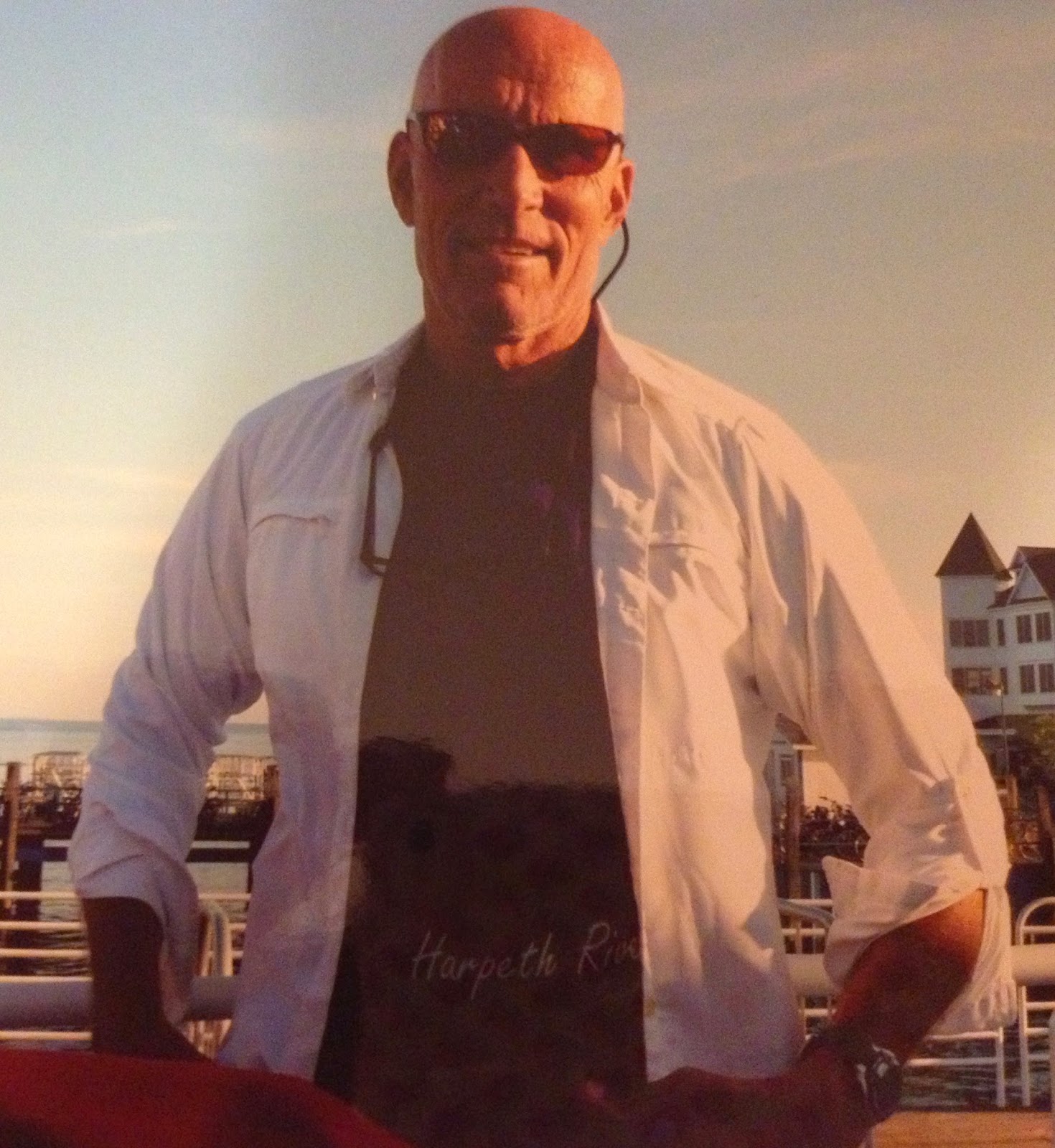
This story seeks to increase awareness and understanding of the unique needs of individuals diagnosed with life-changing illness or injury and their families by providing insight into the life of a man as he went through diagnosis and treatment of brain cancer (Glioblastoma Multiforme - or GBM).
On this day
four years ago, I watched one of the best people I have known take his very last
breath.I held my dad’s hand, kissed
his cheek, and with tears rolling down my face told him I love him for the very last time.It was
a day at the end of a lot of days that I will never forget, and it was the
beginning of an endeavor of a difficulty level that I could not have imagined –
and one for which I could never have adequately prepared.
I’m not
sure if I knew it when I spoke the last words I would ever have the chance to
say to him, but I told my dad something that day that wasn’t the truth: I told
him that I would be ok without him.I
had to say it; I knew that I needed to let him go on ahead with as much peace
as I could offer him after all that he had been through.But, even four years later … I can’t honestly
say that I’m ok, at least not as I used to think of as ok.I’m different, in many ways, and I guess there
is some ok in that.The anguish of
missing him every day and of knowing that he wanted to stay here on this earth
with us so damn bad, along with the things that my family and I learned during
his illness have transformed me forever, for sure.
Grieving in
our culture is often very hard: people seem to expect – and to want – those who are
in mourning to be ok.Messages like “Be strong!” and “He would want you to be happy” are the
standard, and that is one of the things that makes grieving feel like swimming
upstream.
I remember talking
to a friend whose dad had died many years before not long after my dad
died. She was still really grieving, she
told me, and I was stunned. How conveniently
naïve I was, about grief and about a lot of things, before the lines were
blurred. Sometimes,
when I think about my dad’s going on ahead, about not having him with us here on this
earth anymore, my breath catches in my throat and I think, "I am not ready
for this."I know now that, like my
friend and like so many others who have walked this path, I will never be really
done grieving … and I think that’s the ok that I am left with.
There’s
a lot that bothers me about the handling of the news about Brittany Maynard,
the 29 year-old woman who chose to hasten the end of her life after she was diagnosed with
Glioblastoma Multiforme (GBM).Probably
the thing that disturbs me the most is the confident way that so many people
have commented on her story and her decisions, as if they have any idea what
has really been going on behind closed doors in her life.
As someone
who was there on the scene for most of the 75 days between my dad’s diagnosis
of GBM and his death, I feel like I have a fairly good idea what was going on,
but I also know as a result of my experience that there are some things – even
in highly publicized cases like hers – that anyone on the fringe or further out
cannot know, and that’s the way it should be. Health issues are private and personal. The fact of the matter is that even with as healthy as Brittany looked
when her image appeared in the news just days before her death we don’t know
what the cancer inside her brain was doing to her, and we don’t know the
intricacies of her diagnosis or prognosis.
Another
thing that disturbs me is the way the media has portrayed Brittany as a hero,
as if she was a crusader of sorts because of a personal choice she made to make another
personal choice public.To me, it seem like this
implies that a person who does not make the same choices that she made is not as
important or as courageous.I'm glad that
Brittany and her family had the opportunity to make the choices that they made,
but I also think that people in other situations need an equal amount of
respect and compassion. And my bet is that she neither viewed herself as a hero nor wanted to be viewed as one; like the rest of us, she was probably just doing the best she could to get through life and the hand that she was dealt in life.
The
tricky thing about commenting on such an emotionally charged topic is that
logic often takes a back seat in such a situation, as does respect for the
views of others. I have had a hard time figuring out exactly what I want to say about Brittany’s story because I
see the irony in producing commentary about the error I think others are making
by commenting about the case.The potential
for expressing bias as fact, judgment, condemnation, shaming, and labeling is huge;
this is what we tend to resort to when threatened or frightened -- and there's not much, if anything, in life that's scarier than facing pain and the end of life. When I think about the many comments that have been made about how Brittany chose to handle her medical condition, most of which have seemed judgmental and harsh to me, I can't quite get
past the hypocrisy of saying "Shame on you for shaming someone else"
or the irony of judging someone for being judgmental.
Here’s
a confession: when I read about Brittany’s success in doing some of the things on her Bucket List, I felt jealous and even a little angry.My dad had a Bucket List too, but he wasn’t
able to get to any of the items on his agenda because of what GBM took from him
from the moment the condition revealed itself.I also felt jealous that Brittany’s medical
team seemed to have communicated with her clearly about her options … or maybe
she was just more able to figure out what her options were because the cancer
in her brain hadn’t impaired that cognitive skill in her … yet.
My
dad’s doctors, especially his oncologist, didn’t seem to have an accurate view
of what was happening when he went into a downward spiral.It seems like an oncologist would be much
better attuned to medical facts so as not to succumb to the attraction of
denial, but that was not the situation in my dad’s case.
I
honestly don’t know what my dad would have done had we had all of the facts,
had he been able to adequately process things, and had he had an opportunity to
make a choice that would not put his family in jeopardy in any way.I know that it would have been nice to have
someone – anyone – ask him, or us, about his priorities.The medical team was evidently too rushed, too
uneducated, or too something to think to ask him, and we didn’t know to ask (or
what to ask or how to ask it) or to speak up on his behalf until the very end.
As
I've said and written about, the diagnosis of brain cancer, especially GBM, is
particularly devastating for many reasons.As a result of the attention brought to GBM by Brittany’s case, NBC news
wrote an article about the unique challenges with brain cancer:
The
neuro-oncologist who called me to announce that my dad’s case had been accepted
by Duke University is quoted in the article:“Brain
tumors,” he says, “particularly but not exclusively the malignant ones … are in
such an eloquent area of the body that surgical intervention may not be
possible and other interventions such as radiation therapy may come with a
fierce price.” Yet another thing I wish
I wasn’t in a position to have to know truth of.
Recurrence of GBM, the article says, is inevitable, at least as
the treatment options now stand.As I
wrote about in the last post, this is especially true in
certain variations of GBM.
Another thing that bothers me about the coverage of Brittany’s
story is the overuse of the phrase “death with dignity.”
Maybe it’s just a weird point of sensitivity of mine, but I don’t like
the fact that that phrase seems to imply that there is no dignity in making a
different choice – or in not having a choice – about the specifics of an
impending death. That feels like a
really sick kind of competitiveness: who did death better??? Even the phrase “the right to die” seems muddled
to me: I’m pretty sure that dying is a natural process rooted in science, not a
“right.” I think better terminology is “to hasten the end of one’s life” or
something similar that better captures the fact that one's time on this earth is not going to be long with a diagnosis like this, no matter how things are handled.
We can’t know what the specifics of Brittany’s medical condition were, and we can’t know what she thought or felt when the
news of the prognosis and the path she would likely have to travel were delivered. In an instant, though, her choices - and life as she knew it - were stripped away. I think, like a lot of
people with terminal diagnoses who consider “physician-assisted suicide,” that
she was desperately trying to gain some control in a situation that was horribly out of control, and I get that.If you’ve
ever seen someone have a seizure, if you’ve ever seen the terror and confusion
in the eyes of someone who is aware that their own mental state is impaired, or
if you’ve ever seen the look of humiliation and angst on the face of an adult
who has wet his pants because he couldn’t make it to the bathroom in time, then you might have a little bit of an idea of what she and her family were feeling. If you love a person who is having to endure things like this, plus a
significant amount of often unrelenting physical and emotional pain - and who is being told that death is imminent, then
there’s a chance that maybe you can relate to what it’s like to
feel such a desperate need to try to establish order and control.
I
wish I could say that I can’t imagine what it took for Brittany’s family to
support her decision; I’ve tried thinking about what it must have been like on their last night with her or in the last hour they had together before what they knew was going to happen
happened; it’s a different kind of horror, I would imagine, than what my dad
and my family experienced – but, I would guess, the same kind of love.
This is a song that my dad loved, played by a musician named
Bernard Stanley"Acker" Bilk who died earlier this week.
Four years
ago today, I was presenting - for the first time in my career - at a national conference. I had spent the first part of the week with my
family at my sister’s family’s house in California and had flown from there to
Minneapolis to go to the conference.
My husband and my daughters had taken a flight from L.A. back home where
I planned to meet them in a few days after the conference had ended.
Things were
humming along.I actually remember
walking out the door of my house to leave on the trip to go to L.A.; I wouldn’t normally remember something like that from years ago, but
there were two things that have made that memory stick in my head.I remember feeling a little more jittery than
I typically do when I leave to go out of town, because this time I was
traveling in a triangular pattern, first for pleasure and then for business,
and I was nervous that I was forgetting something that I would need on the trip.The second
reason that I still remember leaving my house that day four years ago is that I
got a concerning text message from my dad just as I was getting into the car to go to the airport.As it turned out, that was the last text that
I ever got from him - but that's not why I thought the text was important at the time I received my dad's message.
When I heard the ding on my phone indicating that I’d gotten a text, I grabbed my cell phone out of my purse so I could read the message
as my husband drove to the airport.“Met with grandmom’s dr to sign hospice papers.Hope the girls take news ok,” Dad had
typed in his typical shorthand form of texting.As usual, I was able to read between the
lines to understand what he meant despite the somewhat cryptic qualities of his
message: At the age of 90, my grandmother (his mother) had been very ill for
over two years. My parents had just met with her doctor to discuss her plan of
care because of health problems she had been
experiencing.She had been moved into a
nursing home a couple of years before due to significant cognitive decline, and
at that point she had severe swallowing problems and progressing overall
physical weakness.In the meeting, I
found out later, my parents had been told that her condition was continuing to worsen and that she likely only had a few weeks
left to live.My dad, acting as her
representative for medical power of attorney, agreed that adding hospice
services to supplement the care she was getting in the skilled nursing facility
was in her best interest. As his message conveyed, he was concerned about how my daughters and the other grandchildren would take the news of Grandmom's worsening condition.
Although I
could tell what he meant by what he had written, what I realized I didn’t
know as I processed the news was how he felt.Like his mother, my dad was never very touchy-feely; there were many occasions in my life that I witnessed him keeping a stiff
upper lip so as not to show his emotions and several other times when it seemed
like he was just more of the mindset of “Let’s get this over
with” than “Let’s think it over and share how we feel about it.”As he liked to say: “It is what it is …
because what else would it be?”But on
this day, as my husband drove down the interstate, I felt like I needed to
somehow acknowledge the emotions I thought it was safe to guess that he was
experiencing, and so I texted back, “You are a good son.Your mom knows that you love her, and you are doing all the right things to care for her.”I don’t know
why I chose those words or even why I decided to say something that sentimental
to him at that time; it isn’t usually how we communicated, and that’s why that
moment sticks in my head.Well, that,
and the fact that, as I realized later, in
what seemed like such an ordinary instant when I walked out of my house and
closed the door behind me that day, I was stepping into a life so different from the way I had known it to be.
When I was
about ten years old, my dad entered me into one of the first road races I had
entered as a runner, and, for reasons that escape me now, it was one of the few
times in my running career that I ran in a road race in which he didn’t also
run.
Like many
of the races I participated in during my childhood, this one took place in a small town in Mississippi.In my
mind, the scene at the starting line that day blurs into the hundreds of
other scenes like it, but what happened over the next hour stands out as a
memory all of its own. In this race, to my surprise, I found myself in a small
group of runners that had broken away from the rest of the field about at the first
mile marker.Or, I should say, about at the
point where I thought the first mile marker should have been.For the first seven or eight minutes of the
race, there was silence amongst the four other runners and me except for the
sound of our breathing as we ran.Gradually,
each of us realized that we had probably covered a distance of more than a
mile, and one of the other runners asked if the rest of us were sure that we were going the right way.None of us were; we
had counted on being able to follow signs or directions given by
volunteers along the way so that we would know when we had passed each of the mile
marks and where to turn on the course.As we found out later, though, we'd passed by the first turn faster than the race director had expected, and so there was
nothing/no one there to tell us to make the turn and we had continued to run straight down the street. By the time we realized that we were probably off the course, we were well over a mile past that place where we should have changed
direction.We kept running and
eventually saw an old man watering his front lawn, at which point we slowed to a jog and
one of the other runners shouted to him, “How do we get back to the community center?”
which is where the race finished.The
man looked at us like we were crazy and then pointed back over his shoulder in
almost the opposite direction from the way we were running.For some reason, the five of us still didn’t
stop running; without speaking, we all hung a right at the next street corner
to head in the direction the man had indicated, and eventually we found our way
to the finish line.
Since
October 23, 2010, the day when the cancer in my dad’s brain was discovered, in
many ways I have felt like I did out there on the course in that race so many
years ago: lost, confused, exhausted, and in a state of disbelief as to how the
whole thing even happened.But, also
like my experience in that race, I am comforted by the fact that I am not
having to cover the distance by myself, and somehow that gives me the strength
I need to continue along the course.
And that, I
guess, is one way that I have changed, in increments over the past few years: I
have come to see and to believe that it is human tendency to adjust despite
pain and loss – and that resilience is born of character and nurtured by
love and connection.
I recently came across something written by a woman that I found to be simultaneously heartbreaking and inspiring. This article, which ran in Vogue magazine entitled "The Long Road Back: How to Keep Going After the Unimaginable Happens," is the story of tragedy - but it is even more about love and strength and coping. I found some of the words of the author, whose name is Madonna Badger, to be particularly moving. When she recounts the two things that happened that she found helpful as she was going through the boxes in the warehouse, it makes me think back to the students with whom I worked in the months after my dad died. Like Badger, through my work, I saw two things occur that nudged me in the right direction in the early depths of my grief: I too had to stay "in the present moment," and I saw for the first time that, although there was often ample opportunity for the grief that was upon others around me to incapacitate them, the people who made certain choices in the midst of hardship were able to survive without losing more of themselves than they had been forced to through the adversity. That, I guess, was my push towards perspective.
Before my
dad went on ahead, I’d never really considered the way that the birthday of a
loved one can transform from something that fills you with anticipation and excitement
to something that seems so sad.It seems so odd to me the way that happens; certainly I still want to recognize and
celebrate the birth of one of the most important people in my life, even when
he isn’t still here to celebrate himself. I think for my family, the sense of enhanced sorrow and grief that comes
with this week is exacerbated by the fact that it was the same
week that he was diagnosed with the brain cancer that took his life only ten
short weeks later.That, as much as his
absence, makes it seem counterintuitive to celebrate.
For me, in fact, it feels like salt is being
rubbed into a wound, and a lot of the emotions that are usually just hanging out beneath the
surface on a typical day seem to be bubbling up and threatening to erupt with the week when
everything changed for my dad, for my family, and for me.The annual marker, which I prefer to avoid
thinking of as an anniversary since I tend to think of anniversaries as happy
and worthy of celebration, approaches without hesitation and haunts us without regard
to our ongoing pain. The week represents such a major shift
- an ending of things as they were and an awareness of what should have
been.
I long for just one more hour, one
more conversation, one more hug, one more anything with him.I want to push through the pain and focus on
the importance of the day of the year on which the man who means so much to me
came into this world; the challenge to do so is far greater than I ever
imagined it would be. There are so many things that my dad will not get to
experience now, things he would so love to be a part of or to know about or to
see.His presence in my life continues
to shape me on a daily basis, and I do celebrate that fact as much as the grief
will allow. Sometimes though, especially when I can’t avoid the what if, the should
have, or the should be kind of thinking pattern, I am overwhelmed by it all,
missing him so much that I struggle to move through the ache. The only
thing that seems to be of comfort to me when I think about those things is to remember the life
that he led that I know he considered to be a great one, to recall the way he
was filled with such joy and gratitude, and to recognize the fact that I know
if he knew anything at all for certain during the days of his illness it was
that he was loved.Happy birthday, Dad;
you are loved and you are missed.