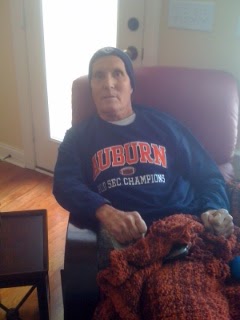
This story seeks to increase awareness and understanding of the unique needs of individuals diagnosed with life-changing illness or injury and their families by providing insight into the life of a man as he went through diagnosis and treatment of brain cancer (Glioblastoma Multiforme - or GBM).
One of the many things that has surprised and frustrated me since my family learned about my dad's diagnosis of brain cancer is the lack of awareness and knowledge possessed by the medical world as a whole about the specifics of Glioblastoma Multiforme, or GBM. I understand that the average person probably hasn't ever heard of GBM. Because it's rare, it's just not something that most people have ever had to know about. Unlike more common types of cancer like breast cancer, lung cancer, and prostate cancer, most people probably don't know someone who has had GBM (lucky for them). I find it appalling, though, that the medical community, outside of oncologists and neurosurgeons, by and large has never even heard of the diagnosis. Last fall, I went to a family doctor to get established as a new patient in the practice. When the physician came into the room, she introduced herself and then sat down on the rolling stool. As she asked me questions about my medical history and about my family's medical history, she typed in my answers on a laptop computer. Eventually we came to the part where she asked about my parents' health, and I told her that my dad had died of GBM. "How old was he?" she asked, and I gave her the same information that I have given many times about how he was only 67 and was active and seemed to be the picture of health. In fact, I told her, he was training for an Ironman triathlon. "Did he swim in a lake to train for that?" she asked, which in all honestly I thought was a little off-topic. Yes, I told her. "Oh," she said, "is that where he got the GBM?" Her question disoriented me, and it took me a minute to respond. "No," I said, trying really hard to control the anger I felt creeping into my body. "The cause of brain cancer is unknown." She blinked a few times and then said, "Oh! I'm sorry - I thought GBM was a parasite," she said.
I liked this doctor; she seemed thorough and smart and kind, but the exchange brought to my attention yet again how much of a gap there is in what medical professionals are being taught about this disease. That's one reason I am so glad whenever I see GBM featured in the media as it will be in the soon-to-be-released film "Surviving Terminal Cancer" aimed at promoting patient advocacy and public education about cancer and research.
The film features the story of a man who has lived for 19 years after he was diagnosed with GBM, a disease that has a median survival rate of 14.6 months with the accepted protocol treatment: This film charts the remarkable story of Ben Williams, professor emeritus of experimental psychology at University of California, San Diego. Diagnosed in 1995 with the most lethal cancer known to medicine, a primary brain tumour called glioblastoma multiforme, he was given just a few months to live. But a natural born maverick, and rigorous scientist, Ben decided he would not go down without a fight. Nineteen years later his story is an inspiration to patients the world over, whilst his case is dismissed by the medical community as just one of a handful of statistical outliers.
"Why are we sticking with a treatment protocol that obviously doesn't work?" the filmmakers ask, as anyone who learns about Ben's story will ask. The film looks at several less well-known treatment options for cancers like GBM, including some off-brand uses of certain medications and vaccines, like the modified polio vaccine that is currently being used at Preston Robert Tisch Brain Tumor Center at Duke University (where we took my dad for treatment, although he got a different type of treatment, not a vaccine).
Another reason that I am so interested in this film is that I personally interacted with Ben Williams through email correspondence during the time that my dad was sick. I connected with Ben when I came across his story on a website called Clinical Trials and Noteworthy Treatments for Brain Tumors during one of the many late-night Internet searches I was desperately conducting. I sent him a message through the website with a brief description of my dad's medical information, closing by saying "We want to be as thorough as possible in looking at treatment options for both now and in the future. Your story is among the few things keeping us going as we begin our battle with this terrible disease. I would love to get your advice if possible." He emailed me in response later that same day:
With that, he and I entered into a fast-paced exchange of emails, with the communication mostly consisting of me asking questions and him providing more in-depth advice and information about what the data in the research had shown about various treatment regiments, including the use of several types of chemotherapy other than what my dad was taking, off-label use of medications like calcium channel blockers, and various vitamin and herbal supplements. He had a remarkable way of explaining very complex scientific and medical issues, like gene segments and pharmacological cross-tolerance; I felt like I had access to someone who knew something that might possibly save my dad's life. I read and reread every email he sent and made long lists of questions which I later posed to Dad's oncologist. Instead of thinking "Why him? How did he get this horrible disease when he seemed to have everything going in his favor?" I began to catch myself thinking, "Why not him? Why can't he be the one to beat the odds like Ben has been?" I believed that we would find a treatment that would work for him, and I believed that he would be ok.
But, as it turned out, I was wrong. Dad didn't get better; in fact, he was getting worse by the day at that point. Four days after I got the last email from Ben, which included specifics about what he felt we should ask the oncologist to consider, Dad was taken again by ambulance to the hospital, and, although we did not know it at the time, we were propelled into what ended up being the beginning of the end.
Reports came out today about former TV star Valerie Harper having been diagnosed with terminal brain cancer. Harper, 73, played Rhoda on the Mary Tyler Moore Show from 1970 until 1974, after which she had her own spin-off show called "Rhoda" until 1978. She wrote a tell-all book called "I, Rhoda" that came out in January this year. She went through treatment for lung cancer in 2009; her diagnosis at this time is Leptomeningeal Carcinomatosis, or LC, which occurs when cancer cells, usually as a relapse from cancer originally in another part of the body, invade the subarachnoid space, enter the cerebrospinal fluid, and are transported throughout the central nervous system. LC occurs in up to 8% of patients with cancer, most often in cases of lung cancers, breast cancers, GI tract cancers, and melanomas. I didn't know all of that about LC until recently. I follow a blog - Family Bonding Time - about a husband and wife who were both diagnosed with cancer almost simultaneously, and the wife, who has breast cancer, was diagnosed in January with LC as well. In reading about it, I was shocked to learn that LC can come from the spread of GBM, the type of primary brain cancer that my dad had. We had been told by the team of oncologists and neuro-oncologists that GBM almost never spreads and that we shouldn't be concerned about that for Dad. (Looking back, I wonder if the reason they said that is because they suspected that he wouldn't last long enough for any spreading to occur.) Apparently in cases of LC, often nothing new shows up on scans because the cancer has spread into the spinal fluid rather than through an increase in the number or tumors or in tumor size. Symptoms of LC, of course, are very similar to those of other types of brain cancer, including GBM, but a couple of the markers for LC listed in the information I read caught my eye: extreme lethargy and severe pain reported diffusely in the top of the head, both of which cannot be explained otherwise, as in they do not seem to be coming from other sources like a side-effect of medication or the location of a tumor. Both of these things were true for my dad, especially during the last month of his life, when he was so tired he could hardly keep his eyes open (but oddly and torturously for him he couldn't sleep because of the massive doses of steroids he was on - because he kept reporting severe pain on the top of his head!). I guess it doesn't matter, does it? I guess they could have done a spinal tap to check for the presence of cancer cells in the spinal fluid - and actually they did consider doing that to check for meningitis at one point, but then they decided just to treat him with antibiotics that would treat any type of infection instead. If they had found LC, in theory they could possibly have treated it with chemo administered through a catheter into that part of his brain, but honestly I doubt he could have tolerated or withstood that treatment, and I guess I'm glad we didn't have to make the decision of whether or not to put him through such a drastic intervention when it was not very likely to buy him much more time, if any, in his condition. I will never get over the fact, though, that no one on the team of specialists who were assigned to Dad's case towards the end, could even venture to guess why he was going downhill so rapidly, especially after he had been given transfusions and heavy doses of medications to restore his blood counts to within normal limits. "On paper, he should be better," his oncologist said, but he wasn't, and I will never forget those words.
In reading the book "Final Gifts: Understanding the Special Awareness, Needs, and Communications of the Dying," by Maggie Callanan and Patricia Kelly, I came across many things that spoke to me in regards to what my family and I had experienced during the end of Dad's illness. I read the book with a goal of gaining some insight and perhaps even some perspective about my dad's death, and, in the process, I began to see that there might be another reason for the recent changes in my grandmother's emotional state besides the cognitive decline associated with her medical condition.
One section of the book is about things that may be needed in order for a person to die peacefully:
"Some people realize a need for reconciliation. Some request the removal of a barrier standing in the way of a peaceful death. Still others need particular circumstances to die peacefully - perhaps choosing the time of their death or the people who will be there.
Realizing what they need, dying people often become concerned; some communicate a tremendous urgency. Coherent requests usually bring action. But requests that are vague or indirect may be missed or ignored, leading to frustration, anxiety, and sometimes agitation. If the awareness of an important need comes late - when death seems to be imminent - the person may delay or prolong the process of dying in an attempt to settle an issue or effect a final reconciliatory meeting.
A person's anxiety, agitation, or prolonged dying can be upsetting for everyone ... Often, the response to agitation is to sedate the patient ... Sedatives may help relieve agitation, but medicines alone are not the answer."
Reading these passages caused me to see some things in a new light, not just about my dad's passing but about Grandmom in her terminal condition, including the fact that our decision not to tell her about Dad's illness or his death might not be the best choice. According to the authors, "Sometimes a family decides to withhold info about the death of someone the dying person knows. While this is typically done out of kindness and concern, the truth often brings peace instead of discomfort or upset to the dying person."
I shared that insight with my mom and my sisters, and we decided that Grandmom needed to be told about Dad. None of us wanted to do it, but we believed it was in her best interest and we hoped the information would help to ease her mind. As my sister Jennifer recounts, "We were so worried that she would get the idea that he abandoned her, that he didn't want to visit her again, or maybe even that he didn't love her anymore, and of course we wanted to do anything we could to prevent her from those thoughts, which of course were absolutely untrue." We resolved to tell her the next time one of us could go with Mom to visit her.
Shortly after that, on the Tuesday before Dad's burial was scheduled on Saturday, Jennifer arrived at our parents' house, and she and Mom went together to see Grandmom. Here is Jennifer's recollection of what happened when they got to the nursing home:
We rounded the corner and saw that Grandmom was sitting up in her wheelchair, which was parked just outside her bedroom door. We greeted her, and then I kneeled down right in front of her and held both of her fragile hands in mine. I said something like this:
"Grandmom, I want to tell you something that might make you sad, but I feel like you need to know, and I don't want you to worry. Bill was sick and had cancer. He went to the best doctors and the best hospitals, but, even as strong as he was, he was not able to fight off the cancer. He passed away and is in heaven now with God and with Roy [our grandfather, Grandmom's late husband]. He is not in any pain. You should not worry. Vicki and Stephanie and Nancy and I were all with him while he was sick, and we took good care of him. He always asked about you and tried so hard to come back to see you again, but he was too sick. You were so important to him, and he loved you so much. We promised him that we will take care of you no matter what. Then, when God decides it is your time, you will get to go to heaven and be with Bill and Roy again."
Somehow I did it without crying -- I just felt really focused on giving Grandmom some relief and definitely did not want to cause her any additional sadness or worry about why I was sad, and so I just talked clearly and slowly and looked right into her eyes and told her. She wasn't really able to talk much, but she definitely seemed to be listening to me, and I truly think had a look of relief and understanding on her face after she heard the news. She did not cry. A little while later, when we left, I hugged her again and told her I loved her and that Dad loved her and that we did not want her to worry.
In the days that followed and over the course of the next two months, the nurses reported that she was sleeping better and was much less anxious. She required fewer medications and wasn't crying anymore. We like to think it was because she understood that her son loved her until he took his last breath and that, given the information about what had happened to Dad, she was able to hold onto the belief that he had gone on ahead but was waiting for her in heaven.
To Be Continued - Part 4 of Grandmom's Story, Coming Soon
There in the hospital bed in my parents’ den on New Year’s Eve, it was so apparent that Dad was so sick. Yet I was still desperately clinging to the Hope that just being at home would help him. I don’t think that I still thought that a cure - or even long-term survival - was a possibility. At some point in the days before, I had bargained those things away: Just let him feel better, just let him get home, just let him not be scared or in pain, I thought. He was home, and we were so, so glad and grateful for that, but we were still waiting on the other two parts of the Deal to come through.
There was a definite sense of protectiveness in the house at that point; we were all racking our brains for what else we could do to help Dad. My brother-in-law Peter brought him food and a Diet Coke from Sonic, but he slept so long that the food got cold and the drink got watery from the ice melting. My sister Nancy figured out how to empty the catheter bag, and we carefully administered the medications right on time. We cut one of Dad’s shirts up the back and gently put it on him, and we kept him covered with blankets so he wouldn’t be cold.
We kept telling ourselves that we weren’t painting ourselves into a corner by deciding to sign up for support from hospice; we said to ourselves and to each other that we could always revoke. I didn’t want anything to be for sure; looking back now, I think I had to keep the door open in my mind to keep from completely crumbling. At the time, I kept thinking about that picture of a bird that has been caged and is being let go and below the picture it says “If you love something, set it free.” Every time that picture popped into my head, I thought SCREW THAT! Dad isn’t caged except by this monstrous cancer and the pain and anguish it’s causing him, and he doesn’t want to go! We didn’t want him to go either – and I wasn’t sure that I could stand it if he did – but we wanted the suffering, which was so undeniable at that point, to be over for him.
As the clock moved closer to midnight on New Year’s Eve, most of our group went to spend the night at my aunt’s house nearby. Mom went to lie down in my parents’ bed in the bedroom, and Jennifer and I planned to split the night taking care of Dad, with Peter providing back-up support when we needed help to reposition Dad in the bed or to get medicine or something to drink for him from the kitchen. Jennifer took the first half of the night; when I tagged in for the second half, she told me that Dad was uncomfortable and anxious and that he really seemed to want someone to stay right with him. She had pushed one of the couches over so that it was right up next to the hospital bed, but the bed was higher than the couch and so she had been lying wedged in between the couch and the bed so that she could hold Dad’s hand and be close enough to him to hear his gravelly voice without disturbing or hurting him. Just like the New Year had slipped in unnoticed in the house, I slipped into her place on the couch as she slipped out. Dad didn’t react at the time, but a little while later, when he opened his eyes and saw me there, he did a roll-call of sorts: he asked me where every person in the family was, as if he were just checking to be sure they were all ok.
We were quiet for a while, but I could tell he wasn’t asleep. Then, with great sadness in his voice, he threw out words that cut me to the core: “I wanted to go out like a man!”I wanted to tell him that he wasn’t going anywhere, but I knew in my heart that I couldn’t make that promise anymore. So I told him about something that I remembered from many years before: I reminded him of one time when he'd had to quit in the middle of a race he was running because his calf muscles had cramped up. He’d hobbled along the road until he couldn’t anymore. We pulled up beside him in the car, and he got in and propped his legs up on the dashboard. I could see that his calves were in knots, and I could see the pain in his eyes along with the shame and disappointment he'd felt as he’d told us that his body just couldn’t go any further. That night, I looked at him lying in that hospital bed, and I could tell he was listening intently. I wanted him to realize that he just needed to keep going for as long as he could but that, when he couldn’t do it anymore, we would understand, we would know without a doubt that he'd given it his all, we would still be fiercely proud of him, and he would not be any less of a man or worthy of anything less than complete respect.
He took all of that in, and then he said, “I guess I’m glad you remember that story.”
“Why?” I asked hopefully. “Because it was a good lesson in knowing that even the toughest of people have limits?”
“No,” he said, “Because it means that nothing is wrong with your memory, so that means you don’t have a brain tumor.”
I was trying hard to keep up with his thought process, but I was struggling. “Dad!" I said. "You remember it too! It’s just part of your story, and I know you remember it.”
He thought for a minute, and then he said very seriously, “Yes, but I don’t think I always will, or maybe I just won’t always be able to tell about it or other things that have happened.”
Maybe I wasn't sure of exactly what he was saying, or maybe I just didn't want to be sure.“Don’t worry, Dad,” I told him, grateful for the darkness of the room that I thought was hiding my tears from him, “I’ll remember all of the stories, and I’ll tell them all.”
He dozed for a short period of time after that, and I remember lying there thinking about how when I was growing up, my mom had always said that whatever you are doing on New Year’s Day would be indicative of what you would spend a lot of time doing the rest of the year. I closed my eyes, but even that didn’t keep the tears from falling furiously as I wished with all of my might that that would be true, that I would get to spend more time with my dad in the New Year.
And so the New Deal was struck, the PICC line was placed, and – thankfully, I thought – our regular oncologist was scheduled to come back on duty after the long holiday weekend.
The kids made posters and signs for Dad, which we taped all around his hospital room. Our focus became encouragement, even more than before and even over medical intervention, and I believed that together we could WILL Dad to get better.
Making "We love you, Gramps!" signs
Overnight at that point, Dad’s emotions went from worry and sadness to anger to determination, with the latter aimed at eating.Dad talked almost constantly about trying to eat, at one point even saying that he felt like his appetite would come back if he could just go out to eat. (Luckily, he acquiesced in that effort and agreed to eat some food that we got “to go” from a restaurant outside the hospital.)The PICC-line was being used for blood draws and IV meds, but, when we asked when the supplemental feeding would begin, the night-shift nurse told us it wouldn’t be until later in the day at the earliest because a “nutritional support” consult had to be completed first, and she added that, if Dad continued to eat like he had been overnight, “the port probably wouldn’t be used for nutrition because it’s better for him to get calories by eating.”
Right at 7 a.m., our regular oncologist came in to see Dad for his morning rounds, his first time to see Dad in four days. In what would become the second-to-most anger-inducing statement made around me by a medical staff member during the entire time Dad was sick (the first being said by the stand-in oncologist said on Christmas Day) , the oncologist jokingly said to Dad, “What happened? You were supposed to be better by now!”
Although I remember these words as if they had just been spoken, I don’t remember what I said back, if anything. I do, however, recall what I WANTED to say: “He was supposed to ‘get better’ from the surgery, from rehab, and from the Avastin! We were supposed to be taking him to a Grizzlies game tonight instead of being here in the hospital. We were supposed to have a memorable family celebration on Christmas at my parents’ house. In fact, if we’re talking ‘what happened’s’ and ‘supposed to’s,’ he was supposed to live to be 100!”There were so many things that were supposed to have been happening, but none of it was going according to plan, and at that point none of it even mattered; we just wanted the doctors to figure out how to get Dad feeling better.
After his opening statement, the oncologist looked at us sitting in the tiny, hard chairs around Dad’s bed in the freezing cold ICU room and said he wasn’t sure why Dad had been admitted to the unit in the first place. He chortled at the surgical masks we were all wearing and said that, since Dad’s blood count was in the normal range even when he was admitted to the ICU, the neutropenic precautions hadn’t been necessary during any of the time we’d been there.
With regards to the PICC line, he said, “That type of feeding will disturb blood sugar levels; it’s mostly sugar.” I wanted to scream, WHY IN HELL ARE WE JUST NOW FINDING THIS OUT? My blood pressure was rising by the second. I so desperately wanted to keep liking this guy, I wanted to trust him, and I wanted him to come in and clean up the mess that I felt had been created in his absence.
The oncologist seemed to think that what had been being done while he wasn’t around was “overkill,” which of course pissed me off beyond belief. (I don’t know if it made me madder to think that things weren’t handled correctly in his absence or just that he seemed to be second-guessing after his long holiday weekend.) He discontinued several medications and decreased a few others. He said he was adding a sleep medication and writing an order for anti-anxiety meds to be given as needed. He said that he wanted Dad to go to a regular floor immediately, for his comfort and for ours and because he felt the ICU-environment “wasn’t working for him.” (No shit, Sherlock!) And then I asked him the question I knew Dad wanted me to ask the most: “What’s it going to take for him to be able to go home?”
“I want his blood pressure to be in a safe range, I want him to be getting up out of bed, and I want him to be eating regularly, and then I’ll discharge him.”
“OK!” Dad said enthusiastically, as if all of that was easy.
At the time, I thought that the oncologist thought Dad was about to get better, and so I viewed these changes as a positive step in the right direction. Looking back, though, I think at best the oncologist was short-sighted, under-informed, and/or thinking wishfully instead of really seeing Dad and his condition as they were; at worst the guy was throwing his hands up and had stopped seeing intensive intervention as being necessary or warranted.
By mid-morning, physical therapy had been ordered, the catheter had been removed, and Dad had been transferred back to the oncology floor. I thought Dad would be encouraged, but he kept forgetting how much longer he had to be in the hospital and what had to happen before he could go home, and he was discouraged and disappointed each time he was told that he probably wouldn’t be able to go home for several more days.
Not long after we got to the new room, the Physical Therapist came in, and together she and I helped Dad sit up on the edge of the bed for six minutes, an effort that completely exhausted and dispirited him. Following that, someone from Pharmacy came in and told us that TPN feeding would begin to be administered through the PICC line later that evening. When I pressed her for details as to why it was going to have been more than 24 hours after the line had been placed before the supplemental nutrition would be started, she didn’t really answer the question but did enlighten us to the fact that, evidently as was standard for all patients who’d just gotten a PICC-line, Dad would be “started slowly” on the TPN feeding, at first getting 700 calories per day and then building up to a maximum of 1000 calories per 24 hours. This was NOT what we had been led to believe before the line was placed. We were told that the PICC line would provide an opportunity for much greater caloric intake. I was enraged, but I gritted my teeth and stayed focused on Dad. What was done was, well, done, and maybe, I reasoned, the extra calories that he could get that way would help him get strong enough to get the hell out of that place.
For the first several hours that we were in the new room, the nursing staff seemed to struggle to accommodate Dad’s needs. Because it was still considered a “holiday week,” the regular oncology floor was shut down, and we were actually on the bone marrow transplant ward. Apparently, the nurses on that floor weren’t at all used to patients with neuro-like problems; most of the other patients there were independently walking laps with their IV-poles trailing them, and some were even going back and forth between their rooms and the little patient kitchen to get snacks or ice for themselves.
But we were floundering. The removal of the catheter seemed like excellent news at first, but it soon became a source of great distress for Dad and for us. Contrary to the oncologist’s apparent idea that Dad would regain his mobility and his strength as soon as he got out of the ICU, Dad, of course, was still bedbound. In fact, he couldn’t even move himself at all in the bed, much less sit up or stand. And thus maneuvering to use the bedpan or the urinal was difficult, to put it mildly (and, at that point, the idea of his using a bedside commode or getting up on a walker to make it to the toilet in the bathroom seemed like looking at the finish line of a marathon from the vantage point of mile one).
Humiliatingly and frustratingly to him, Dad had more than one mishap with the urinal. We were ready to do whatever it took to help him, but at the same time we wanted to try to preserve whatever was left of his dignity. When Dad’s sheets got wet the first time, I pushed the call button, and, when we hadn’t gotten a response more than 5 minutes later, I went out into the hall, found the nurse, and told her that Dad needed to have his sheets changed. “They’re in the linen closet,” she told me with a wave in that general direction, as if that solved the problem.
Fortunately, at shift change we were once again blessed by the Nursing Assignment Fairy; this time the nurse that swooped in to support us was John. Dad was still "giving it his all" to eat; when we clued John into the fact that we were very concerned about Dad’s caloric intake, John offered lots of “extras,” some of which Dad said “yes” to and then ate (including a Snickers bar). Without even being asked, he brought extra blankets because Dad continued to say he was cold, and he provided extra pillows to prop Dad up so that he felt warmer and more secure.
My 16 year-old daughter and I stayed with Dad for the first shift that night; Dad chatted easily with her and even said, “If you can find some popcorn and a Diet Coke, I wouldn’t mind sharing it with you while we watch something on TV.” With John’s help, she procured the snacks, and together they watched “American Chopper” and then a show about hair transplants while he quizzed her about her plans for college.
Throughout his stay in the hospital this second time around, including the four days in the ICU, pain from the bed sore on his lower back had continued to plague Dad. John was excellent at gently re-positioning Dad in different ways in the bed so that the pressure was taken off that area; he made an effort each time he came into the room to explain what he was doing and why to Dad and to us and even had me demonstrate my understanding of skills like propping Dad up with lots of pillows and rolled blankets. He wasn’t just acting as a nurse; he was also a teacher and a friend.
About 9 p.m. that night, John came in to give Dad his night meds, which, without notice to us by the doctor, had been changed to include a psychiatric medication called Restoril. While I wanted Dad to be able to sleep at night, I was very concerned about this choice of medication because I knew that it also affected the muscles and of course alertness and that it could also have several side effects for someone as sick as Dad was. I was also angered that the orders had been changed without any type of discussion with the doctor. It was just one more example of the mis-communication (ornon-communication) and the half-assing that was going on WAY too often.
Dad swallowed that pill and his anti-seizure pills, and, shortly thereafter, he began to get groggy. His voice got so soft that we had to lean in close to him to hear him; with tears in his eyes, he said he wanted to be sure that Mom knew how much he loved her and that he couldn’t make it without her. He patted the space in the bed beside him – his sign for “I want someone to lie beside me” – and my daughter carefully hopped into the bed and tucked in next to him as he drifted off to sleep. About an hour later, my sister Jennifer and her husband arrived for their shift, and, without saying a word, Jennifer and my daughter seamlessly switches places without disturbing Dad. There would be more sleeplessness, more anxiety, more struggles with the urinal, and more medicine that night for Dad, but at least he knew beyond a shadow of a doubt that his family was there with him and, despite what was going on with the medical staff or anything else, that that’s where we planned to stay.
Remembering the days in the ICU and then in that room on the BMT floor, I remember so well feeling so impotent to stop what was happening or to do anything that truly seemed to be helping Dad. I am certain that the care at that hospital in general must be better than what we experienced, but, except for the few instances of competence and compassion from a few member of the nursing staff, it feels like Dad's care was awful from the moment he was wheeled into the ER. Having worked in health care for so long, I know what can sometimes happen – arrogant doctors shuffle in and out, people just work their shifts and do the bare minimum, revolving staff members see patients (and their families) as a short time problem to endure. It’s not right; it’s not fair. But Dad had been caught in the crossfire just the same.
At admission, Mom had provided the hospital staff with a copy of the medication log that we had been using for Dad at home with names, dosages, and dosage times for each of the dozen or so drugs that Dad had been prescribed. Several of these had been switched over to IV-form and added into the IV line; a few were brought in for Dad to take in pill-form as he had been at home, which was a problem because he could barely swallow. Even after a phone call to the oncologist’s nurse and discussion with the nursing staff at the hospital, I was still concerned about the expectation that he could effectively and safely swallow pills and because some of the dosages being administered didn’t match what he’d been taking.
When the oncologist came to see Dad on the oncology floor mid-morning after Dad had been admitted, he rewrote the medication administration orders. He looked at Dad and said that, although he felt it was unlikely that the cancer had advanced at this point given the treatment protocol Dad was on, we couldn’t be sure about anything until we could get an MRI, which he felt wouldn’t be possible for at least another day or two due to Dad’s decreased level of alertness and his pain level.
His main plan seemed to be waiting to figure out what the plan was, which, as the family of any cancer patient knows, is NOT a good plan at all. Delays are Enemy #1 when dealing with an aggressive cancer like Glioblastoma, but, until we knew more about what had caused Dad to decline so rapidly in such a short period of time, waiting was really all we could do.
The oncologist told us that in addition to a blood transfusion and platelets that he was considering ordering to boost Dad’s blood count, he also wanted Dad to get a medication called Neupogen, which is a growth factor that stimulates the production and activation of neutrophils, a type of white blood cell. At the mention of the drug, an alarm went off in my head, and, upon quickly reviewing notes in the Notebook, I saw that Neupogen was listed on the treatment protocol that Dad was on from Duke under Things To Avoid. On the paperwork we’d been given at the Brain Tumor Clinic, I had scribbled a note out to the side that read, “As a growth factor, admin of this rx – potentially counteractive to Avastin.” I showed the info to the oncologist who looked perplexed; evidently, he did not already have this information, even though he had used Avastin to treat other patients before Dad.
The next move was for the oncologist to consult with the neuro-oncologists at Duke who had authored the protocol; our guy said he would get right on that and get back to us on the Neupogen. “We need to get his blood counts back up,” he said as he left the room, “and then he will get exponentially better.”
Dad had had an appointment to get a monitoring-type of MRI that very afternoon and had been scheduled to get Avastin and chemo the next day, and I was filled with disappointment that our plans had had to change. Thinking that we could get some GOOD news for a change, I’d been so focused on getting that follow-up MRI, despite the fact that I, like Dad and like the rest of my family, had developed a raging case of Scanxiety. Now that he was too sick to even get an MRI (and considering the fact that when he did get one it would be to check for problems instead of monitoring for progress), I saw that I should have been grateful for him have the chance to get the scan instead of the alternative, but, as usual, that was all only seen in hindsight. Now, instead of at least having a Plan, we were left with only a cancelled plan and confusion.
And fear. Dad was so weak at this point that he couldn’t lift his head from the pillow, couldn’t suck liquids from a straw, and could barely talk loudly enough for us to hear. He had a deep cough, and the coughing exhausted him and made his throat and chest hurt. When asked, he reported that he had a headache “in the middle” or “in the top” of his head ("seven or seven and a half out of ten" on the pain scale, he said), which of course made us think that the cancer had spread despite the oncologist’s prediction.
For the rest of that day, Dad was in and out of a medicated fog, on a heart monitor, with multiple IV lines going, and getting oxygen through a tube in his nose. In getting him settled in the hospital bed after he was admitted, the nurse had discovered a pressure sore the size of a pencil eraser on his low back. A wound care team consult was ordered, and this area was cleaned, treated, and dressed; Dad later told us that that sore hurt almost as much as his head had been hurting, another dire consequence of an impaired immune system. By late afternoon, the Infectious Disease team had ruled out viral meningitis, and over the next 48 hours cultures were going to be grown in the lab to test for bacterial or fungal meningitis, pneumonia, and other types of infection.
As hard as it had been to get through the stressful, sleepless nights since Dad’s diagnosis, that was nothing in comparison to the first night of the second time Dad hospitalized: it was the first night that I thought that it was entirely possible that Dad wouldn’t survive, not just the cancer but the night. We were lucky enough to have our case assigned that night to a nurse named Meredith, who provided exceptional quality of care for Dad and who took Dad and my family under her wing, even requesting to have Dad as her patient on other shifts she worked while we were on her floor. She provided highly commendable care for Dad and for us; she seemed to see not just Dad but those of us caring for him as her patients, and she gave us not only the physical support we needed but some much-needed emotional support as well. As my sister later said, Meredith appeared to see Dad through our eyes, and that is something that was so significant to us and that we will always remember.
Even in the haze of the pain and the pain medications, Dad strived to be appreciative and polite. With his throat incredibly sore, he offered a husky “Hello!” to the woman who came in to empty the trash can in the room, and he gave a gravely “Thank you!” whenever one of us used a finger to hold liquid in a straw and then release it in his mouth or when we put chapstick on his cracked lips. He, of course, took an instant liking to Meredith, as did we. She bore a resemblance to one of my sister’s best friends from high school, a girl named Angie. Despite the fact that Dad hadn’t seen Angie in many years, he too noticed the similarity in Meredith’s appearance and started calling her Angie, which Meredith said she took as a compliment. “I feel like I’ve known you for a long time, too!” she told Dad, which made him smile and warmed our hearts.
Not long into her shift, Meredith said she had orders to administer Neupogen; I relayed my concerns and the earlier discussion with the oncologist to her, and she put a call in to the doctor to verify the orders. Contrary to his earlier commitment to “get back” to us on the issue, the oncologist hadn’t communicated with us at all on the Neupogen verdict, but over the phone he told Meredith that he had consulted with the doctors at Duke and they had agreed that the priority was to boost Dad’s blood counts and thus the drug should be given. This was the first of many points of confusion and miscommunication (or non-communication) in Dad’s care, but, like the rest of the family, I was grateful that the medicine was being given despite the way we’d found out about it because I was desperate to find something that could help Dad get through what I saw as a bump in the road, even if it took altering the protocol or the plan to do that.
Over the course of the next several days, I worried a lot about how and when Dad could get the next dose of chemo/Avastin; I made fervent notes in the notebook about it in between the times the oncologist came by to check on Dad. When I asked about when Dad could get it again, the oncologist said we needed to get Dad stabilized, and then he added, “Avastin has a three-week shelf life, and it’s only been two weeks since he’s had it, so we aren’t losing ground if we can get it in him within the next week.”
I wanted that Avastin for Dad like I was an addict on a street corner. I was like a boxer warming up before going into the ring, punching the air and wearing a super-tough look on his face. Maybe even growling a little: Here we come, Cancer, and we’re going to kick your ass! But I was wrong. The cancer, the treatment, the illness didn’t even give us a chance to step into the ring. We were so tired of Cancer and of tears and terror; we needed some Good News, but, other than the fact that Dad was still in the game at this point, there were none to be had. Cancer could wreak havoc on Dad’s body, but it couldn’t touch our love.
During the 75 days that Dad was sick, there were parts of him that were still the same from our pre-cancer days, but other things were very changed. The help that he needed was all-encompassing, exhausting, stressful, sad, and draining, but so worthwhile; the only time while he was sick that I felt like I wasn’t free-falling was when I was right by his side. His needs and what felt like the constant activity and vigilance that were necessary were very effective at counteracting our own panic and the sadness and, truth be told, in a weird way, the reality of it all. When I was with Dad, I couldn’t worry about Christmas shopping or paying bills or much of anything else; it took 100% of my focus just to meet his needs. When there were two or more of us there with him, one person was able to be right with him, and the other person could get a little sleep, make something in the kitchen, sort the medications, make phone calls about Dad’s care, do laundry, or work on setting up something else for Dad like the ever-changing therapy schedule, a doctor’s appointment, or the rare outing in the community.
On a daily basis, Dad was battling almost constant headaches, overwhelming fatigue, loss of appetite (he said, “I’m ZERO hungry!” whenever food was offered), and a pervasive feeling of being cold (he frequently asked if the heater was broken or if someone had turned down the thermostat, even though it was set on at least 75 degrees). In typical form, though, Dad mustered his strength and pushed on, as did we.
On the Sunday before the MRI and Round 3 were scheduled, my sister arrived at my parents’ house from California. Dad had been talking about wanting to go to see a movie for a while, and so my sister and Mom called the movie theater nearby and spoke to the manager about the accessibility of the restrooms there. Like the trip to Duke, it wasn’t enough for Dad just to have access to a bathroom with a stall with grab bars; he needed constant cueing to use the walker and to guard against other obstacles like a wet floor and thus wasn’t safe unless someone could directly supervisehim at least in getting close to the toilet, from the toilet to the sink, and from the sink to the door to exit the restroom. As we had discovered on the way to North Carolina, most places don’t have single-stall type of facilities, and neither did the theater. When the situation was explained to the manager, though, he offered to supervise Dad on his trip into and out of the men’s room, and so the “Let’s Go To The Movies” Plan was put in motion.
Mom purchased tickets online to avoid a wait in the cold, and they loaded up into the car. In another example of a change in his usual personality and tendencies, though, when they pulled up in front of the theater, Dad announced that he didn’t really want to go. Concerned that he would regret his choice later, Mom and my sister tried their best to talk him into going in, but to no avail; thinking that it would lure him in, Mom even went into the theater and bought a tub of popcorn – Dad’s favorite thing about going to see a movie – and brought it back out to Dad in the car. Dad was insistent, though, and so the mission was scrubbed.
Once back at my parents’ house, the strain of the day’s events and the sadness of everything going on was evident in Dad; tears flowed as he told my sister and my mom that he didn’t think he would ever be able to do the things he wanted to do again. Like the workings of his memory and the sensation in his left arm that seemed to come and go and that we just couldn’t really predict or comprehend, Dad obviously had a lot going on emotionally. We were right there with him to support him, but he needed more. We felt like we were paddling against the tide, with no lifeguard in sight.
When my sister called to tell me about the afternoon, I put a call into the oncologist. I told him about Dad’s anxiety about the upcoming MRI scan, and he said that he would call in a prescription for an anti-anxiety medication to Walgreen’s.I asked again about an anti-depressant for Dad, and the doctor said we could discuss that at the upcoming appointment.I told him that we are all discouraged at the lack of progress. He said he had been wondering about that too and that he wasn’t sure if the Avastin needed longer to work in this case or if there was some brain damage from before or during the surgery that was either irreversible or just taking longer to heal regardless of the Avastin dosage. He said he was interested to see the results of the MRI scan, which we would go over at the appointment on Wednesday, and that he would speak to the team at Duke about the plan after that.
In the meantime, my sister had made contact with the neuropsychologist from the rehab facility, the tall runner-looking guy to whom Dad had responded so well before our trip to Duke, and the guy had agreed to work Dad in for an appointment right after the MRI scan on Tuesday. With the MRI at the hospital downtown, the appointment in another part of town, and then the candlelight service at a church near my parents’ house that evening, it would be a very full day, but we were hoping for a good result from all three.
Dad loved "The Sound of Music," and this song makes me think about how
we felt like we were climbing mountains, fording streams, and following
rainbows with all the love that we had, in search of a dream.
Part Three of Our Trip To Duke/Our Journey of Hope
My middle sister’s husband took a red-eye flight overnight to join us on our third day in Durham. As happy as my mom, my sister, and I were to have him there for reinforcement, I think Dad was even happier; he was really grateful for some male company. The weather had gotten chilly since we’d gotten there; my brother-in-law had worn a hat and had brought a matching one for Dad, which Dad put on as soon as he got it. It was my sister’s birthday that day; we sang Happy Birthday to her in the hotel room before we left for our second day of appointments at the Brain Tumor Clinic.
The birthday girl with Dad, who's wearing his new hat
Since we had additional support that day, we decided to forego the Shuttle Ride From Hell and have my brother-in-law drop us off at the clinic for our mid-morning appointment so that he could get a couple of hours of sleep in the hotel room and then pack up and check out before picking us up so that we hit the road after the appointment.
We made it to the clinic in plenty of time and were called back into a conference room just a few minutes after our arrival. Doctor #1 from yesterday entered the room along with Doctor #2, the guy who was actually in charge of the clinical trial with Avastin there. They got right down to business, filling us in on what a thorough review of Dad’s records and test results had revealed: “The MRI from just before he left rehab,” Doctor #2 said, “showed that the tumor had more than doubled in size since the debulking four weeks prior to the scan. There was essentially very limited surgical benefit.”
The room was quiet for a minute while we took in this information. I couldn’t stop myself from quickly calculating in my head that if the tumor was originally approximately 4 cm in size and about 80% was removed during the surgery, what was left was about 0.8 cm. Now they were saying that that had more than doubled in only four weeks, plus another five days had passed since the MRI, and so the tumor was probably close to 2 cm in size at this point. And, even more alarmingly, in less than another month, it could potentially be back to the size it was when it was originally discovered. Back to Square One.Damn.
My next thought was how to bolster Dad’s spirits, since at this point I didn't think I could protect him from the news that had just spilled out like a toxic gas leak in the room. I looked over at him and saw him flipping through a magazine that had been left out on the conference table. I couldn’t tell if he'd heard what had been said or not, and I couldn’t decide if I thought it was worse if he had heard it and was in shockorif he was so off-task that he hadn’t even heard the news.
I told myself that we had to focus on what could be done, not what had or hadn’t been done or anything else, and so I charged ahead: “What do we do now?” I asked these men, who were reputed to be some of the leaders in research and treatment of brain cancer in the country.
Their answer was simple: “Let’s get the nurse practitioner in here to explain the details to you and let’s get Avastin going.”
Well, OK. Nurse practitioner came in with a neatly organized 3-ring binder full of info about Avastin and the two types of chemotherapy Dad would be getting according to their protocol. She went over it all in detail and also explained how we could get in touch with someone at their office should we have problems or questions. Just after she finished talking, another nurse stuck her head in the room and said she had just gotten a phone call from the nurse practitioner at Dad’s oncologist’s office at home, who said that since Avastin was not covered by Medicare, they had cancelled the appointment for Dad to get the Avastin and chemo there on Monday. WHAT??? There was some back-and-forth on this between the staff there; finally the nurse practitioner left the room to try to get in touch with Dad’s oncologist to see what was going on.
While she was gone, the two doctors asked if we had any questions about anything for them (heh!) – um, just a few, yeah! We tried to be succinct, but we felt like it was our one-shot at getting a lot of information that we needed to know. They were extremely gracious and patient. We found out that the team at the Brain Tumor Clinic at Duke saw about 750 patients with newly diagnosed GBM yearly (in comparison to the 5 or fewer cases most oncologists saw annually, even in major cities). We discussed alternate treatments that my sister and I had read or heard about and why the doctors felt sure that Avastin was a better option for Dad at this point. We asked about complementary types of medicines like melatonin and other supplements, calcium channel blockers, and Accutane, all of which have been shown in some studies to enhance the positive effects of chemo on this type of brain cancer. Over and over again we heard them say that Avastin was The Magic Bullet for GBM and that, especially paired with these two types of chemotherapy and followed up by radiation as per their protocol, and that they expected us to see good improvement in function for Dad and significant tumor reduction in a relatively short period of time. “It’s the one treatment that can shrink this type of tumor and improve neurological function, sometimes in a matter of days,” Doctor #2 said.
As far as I could tell, Dad wasn’t paying attention to much of what was being discussed in the room during this time; he was still browsing through a month-old copy of Time Magazine (WHY was that even in THERE? Irony, anyone?). When one of the doctors asked him directly if he had any questions, he said, “How did I even get this?” The doctors launched into an analysis of several things that are being researched as possible causation factors for a person with a “predisposition” for this type of cancer – farming chemicals, environmental pollutants, and one that really caught our attention: Agent Orange exposure from time spent in certain areas of Vietnam during the Vietnam War. The doctors said that one of the residents in their clinic was gathering information as part of a long-term study of possible causation factors for GBM and asked if Dad would like to participate. Dad immediately said, “Yes!” I asked what participation would entail, and we were told a blood sample and a DNA sample would be taken, and an interview that would take about an hour and could be done over the phone later would be conducted.Dad was eager to sign the papers to give his consent for that, and then we moved on to the next topic:the treatment protocol.
The Duke regiment for GBM treatment involved getting Avastin and the stronger type of chemo called CPT-11 by I.V. once every other week. For five days every month, the other type of chemo, Temodar, was also administered in pill form. This cycle would repeat over the course of four months, after which the CPT-11 would be discontinued, daily radiation would be added, and the Avastin/Temodar would be continued for another month. And then we would see how things were looking.
The doctors said that Dad could have only one beer per day during chemo because his liver would already be working overtime to process the chemo. ("I guess I can live with that," he said.) They said that the steroids should be tapered over the next few weeks under the direction of the at-home oncologist and that if sleep problems persisted Dad should just take Tylenol PM to help him sleep at night instead of something stronger. We asked about supplements as part of the treatment, and the subject of the use of medicinal marijuana came up. “I’d say you should try to get some of that,” Doctor #1 said. “It can help with sleep, anxiety, and nausea.” Diving right in, my sister asked where we were supposed to get it. “Oh, you know,” Doctor #2 said, “just go to a bar and see who looks like they might have some for sale.” Hmmmm. We weren’t sure about that option, but I wrote down “marijuana” on our to-do list, and the discussion moved on.
They handed us a prescription for nausea, just in case, and they said we should keep something on hand for diarrhea, which was often a side effect of the CPT-11, too. At that, Dad perked up and chimed in, “I HOPE I have diarrhea! Not being able to exercise in weeks is giving me the opposite problem!” Everyone laughed. The doctors encouraged Dad to avoid napping during the daytime and to exercise as much as he could “on the recumbent bike or just walking around the block.” Mom, my sister, and I exchanged looks on that one – Dad had been struggling to get from the bedroom to the den and back a few times daily, using a walker and with someone right beside him for supervision, and so we couldn’t really even imagine him making a loop around the neighborhood. “Just wait!” Doctor #1 said after he saw our exchange. “I predict that by Monday he won’t even need the walker to walk.” OK, sign us up!!
In the midst of the Q & A session, the nurse practitioner came back in and said she had spoken to Dad’s oncologist, who had told her that as far as he knew Avastin was not covered by Medicare for initially-diagnosed GBM, and, at $20,000 a pop, he didn’t want to order it for Dad until the financial end of things was cleared up. After more back-and-forth on this, Doctor #2 left the room for a minute and then came back in and said, “I want him to get Avastin as soon as possible, and so let’s do it here, today. Our financial secretary says that Medicare just started covering it for cases like this last week and that it shouldn’t be a problem, but if it is, our clinic will eat the costs for this dose of it and then your oncologist’s office can have the next two weeks to figure out how they are going to get it covered or paid for before you need it again.”
Wow. It took about 30 seconds for that to sink in, and then Mom, J, and I were in tears. J said, “Thank you!!! It’s my birthday, and this is the best birthday present I’ve ever gotten!” There were smiles all around.
“You’ll need to stay in town another night just to be sure he doesn’t have any unexpected side effects. The chemo lab has one opening left for today, and it’s in ten minutes. Can you stay an extra night, and can you get him right upstairs?” Um, does a bear live in the woods??
With all the commotion, Dad hadn’t really caught on to exactly what had transpired, and so I just gave it to him in a nutshell: “You’re going right now to get the medicine that is really going to help you!”
“Well, let’s go!” Dad said, and we were off to the chemo lab.
By the time we got upstairs and had filled out the paperwork and then gotten called back to the chemo room, Dad was very anxious; he wasn’t sure what was happening and was very overwhelmed. The nurse decided to give him a sedative as soon as he had been hooked up to the I.V., which she did in a flash. She gave us some pamphlets and talked about possible side effects of the treatment. “It's very likely that you will lose your hair,” she said somberly. Dad perked up at the mention of that; he very animatedly said, “How soon will it come out? I hate that I haven’t been able to get my head shaved lately, and I want my head to be completely smooth!” The nurse said that was the first time any of her patients had actually gotten excited about the likelihood of going bald!
Just before Dad drifted off to sleep, he looked at me with wide eyes and said, “I know the doctor said this stuff is really expensive. How am going to pay for it?” I told him that he shouldn’t worry about it because his insurance would cover it, and, with half-closed eyes, he mumbled, “Thanks for the Medicare, Obama!”
While the toxic chemo and Avastin The Magic Bullet slowly dripped into Dad’s veins, he slept so deeply in the chemo recliner that he actually snored a little.Huddled in the corner beside him, I conjured up thoughts of Pac-Man gobbling up the cancer cells (I’d read that this could be helpful and figured what the hell!).Mom and J went back downstairs to meet with the social worker to learn about possible benefits and programs for which Dad might qualify.The nurses bustled around busily, but the room was quiet.The space felt sacred.I focused on the high-dollar juice dripping from the bags on the IV pole and thought, “Bring on the Magic!”