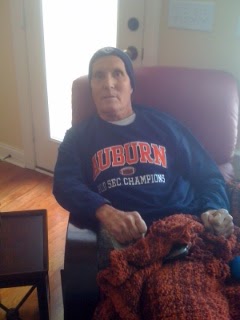
This story seeks to increase awareness and understanding of the unique needs of individuals diagnosed with life-changing illness or injury and their families by providing insight into the life of a man as he went through diagnosis and treatment of brain cancer (Glioblastoma Multiforme - or GBM).
Since my dad went on ahead almost two years ago and especially over the past year, I have been struggling with the fact that the way I see him in my mind is as he was when he was sick, but today when I happened upon a picture of myself helping him walk using his walker I was struck by the fact that he looked even more frail than I remembered. So now I’m troubled by the fact that apparently I don’t clearly see him as he was well or as he was sick, although maybe the latter is for the better.
It wasexcruciating to watch Dad struggle and to witness the physical and psychological effects of his illness as it progressed, especially because I felt that we had all but been promised that there would be improvement after he had gotten the "Magic Bullet drug," Avastin. My heart broke for Dad as I watched him struggle to grasp the severity of his illness, time and time again. As long as I live, I will never forget the look in his eyes when he was struggling to get around on his walker one day not long after he got out of rehab and he stopped for a minute, obviously deep in thought. I was holding onto the waistband at the back of his pants, and he looked back at me with tears suddenly in his eyes and said, "Am I handicapped?"
"No, Dad!" I responded. "You've been through a lot, and you're having to work on some things, but you're going to get better." I was so sure, and, from my perspective, so was everyone else around us, maybe not that he would be cured but definitely that his physical skills would improve with effort and with time.
But that didn't happen. He didn't get better; in fact, he got worse, and little by little his independence and then his life slipped away. Or maybe I should say they were stolen, or ripped away from us, because saying they slipped away implies that we weren't holding on and fighting tooth and nail every step of the way, which we were, Dad included.
I don't think he realized that the end was very near for him those last couple of weeks; likely, the invaders in his brain - the cancer, the trauma from the seizure and the surgery, the chemicals in his body that collected as his organs were shutting down and could no longer filter out the toxins, and the array of medicines he was taking - clouded his knowledge of his rapidly worsening condition.I hope so - Dad didn’t deserve to be given a death sentence. It was heartbreaking enough that the rest of us had to know what was coming down the pipe all too soon.
Falls separate people in a very literal way: the careless from the careful, the clumsy from the coordinated, the weak from the strong, the unlucky from the lucky, and - as in our case - the unhealthy from the healthy. After a fall, one's first instinct is to reassure everyone, including himself, that it was "no big deal," that he is "just fine." It is natural for the one who has fallen to want to “shake it off” and forge ahead as if it didn’t happen at all.
This is an exceptionally hard part of my family’s story to recount because it involves two falls for my dad that marked a turning point for him and for us, watershed moments when Dad stopped being embarrassed about needing help. After the past couple of months of having given it his all to pretend that he didn't need assistance, he was completely drained, and it was the beginning of a struggle from which we just couldn’t disengage. It was heart wrenching and very sobering to see Dad’s acceptance of help after these falls and to see that he was starting to understand just how sick he was.
No one involved in what happened with Dad over the next couple of weeks could give any reassurance that things were ok or any explanation as to why he had gotten so much worse or why he couldn’t recover. We were on our way to the front lines of the battlefield, and we were soon to learn that we had only thought we knew what difficulty and devastation were.
On the Monday before Dad was scheduled for an MRI on Tuesday and Round 3 of chemo and Avastin on Wednesday, my sister stayed at our parents’ house with Dad, and Mom went out for a break with her two sisters. In a few hours’ time, Dad got up and sat for awhile in his recliner in the den and ate a few bites of food at my sister’s insistence, and then he said that he needed to get up to go back to the bathroom. As we had been doing over the past several weeks to help Dad with his balance whenever he walked, my sister held onto the waistband of his pants from behind him to try to steady him. As she recounted later, he seemed more unstable and weaker physically than ever before.
A few steps into the hallway, Dad lost his footing and fell to the ground just behind the couch. My sister cushioned his fall with her body, turning the fall more into more of a controlled collapse, but once Dad was down, he couldn’t get up. He tried, she tried, and they tried together to figure something out, but nothing worked. In the midst of their efforts, the doorbell rang, and my sister could see through the windows by the front door that it was Dad’s swim coach Ashley. She motioned her to come in, and together the two of them were eventually able to get Dad up using the back of the couch for leverage. After they helped him back into his recliner, he strangely acted like nothing had happened, even though he and my sister both had been in tears and had spent at least half an hour feeling utterly helpless on the floor before Ashley had arrived. Dad had great admiration for his swim coach, and my sister said later that she thinks the fact that Ashley was there was the only reason Dad was able to muster enough strength, courage, and perseverance to get up and act like he was ok.
After Ashley left, the Occupational Therapist came for a therapy session that had been scheduled the day before. My sister told the OT what had happened, but he really didn't seem to understand and/or care. He had Dad do some hand exercises from the recliner in an extremely short therapy session in which Dad was very obviously totally disinterested and disengaged. My sister asked the OT to help her get Dad to the bathroom before the guy left; he acted annoyed, but he agreed. The two of them assisted Dad in getting up and behind the walker but quickly realized there was no way he could walk at all; he was just too weak. They ended up pulling a dining room chair over to Dad and lower him onto it, and then they pushed him in the chair along the hardwood floor into the bathroom and then into the bedroom. Once they got him back into the bed, Dad immediately fell into a very deep sleep. It was so undisturbed and so very uncharacteristic for Dad at the time that while he slept over the next few hours my sister sat in the bedroom on the floor and watched his chest rise and fall the whole time. At one point, she took a video of Dad’s breathing pattern on her cell phone and then called me to tell me that something just seemed really, really wrong. (By the way, the therapist hauled ass out of there right after Dad was back in bed, leaving my sister alone at the house with Dad with no way to get him out of the bed if he needed the bathroom again or anything else for that matter.)
I had planned to arrive at my parents’ house the next morning, and, since Dad wasn’t hurt physically, we decided to just let him rest until then so that the three of us could get him to the appointments as scheduled over the next couple of days. In full Bargaining/Denial mode, I told my sister and myself that Dad had just worn himself out with all of the activity over the past couple of days and that he just needed some extra rest.
That night, as was the routine during that time, Mom took the first shift with Dad, talking to him about the plan for the next day which included the MRI, the visit with the neuropsychologist, and the candlelight church service. Dad was still very anxious about the MRI but seemed to accept that we would be right there with him when the results were read the following day and that we just needed to get through it and then go from there.
Around 3:00 a.m., Dad informed Mom that he needed to get up to go to the bathroom. She turned on the light and then helped him get up with the walker and into the bathroom adjoining their bedroom. Dad had been soloing in the little “toilet stall” room and did the same that night, but after going to the bathroom he lost his balance. He fell against the wall and slid to the ground. Mom yelled for my sister, who rushed in to help. It was a repeat of the afternoon fall, except that this time even two people wasn’t enough to support Dad. They tried different maneuvers and various strategies but nothing worked. Finally, in desperation, they called 9-1-1.
Thinking that Dad would resist having other people come in to help, neither my sister nor Mom wanted to tell Dad that they had made the call. The ambulance arrived in a matter of minutes, and, when Dad saw the paramedics, a look of sheer relief washed over his face. Two strong men carefully picked Dad up and put him back onto his bed. They checked him over and declared that he somehow didn’t have any breaks or bruises, but after some discussion it was decided that they should transport him to the hospital due to concerns about the decline in his physical status that seemed to indicate a worsening in his medical condition.
Mom rode with Dad in the ambulance; Dad’s anxiety actually seemed to be mitigated by the decision to go to the Emergency Room. My sister called me and told me to meet them at the hospital instead of at my parents’ house as planned, I called our other sister, and we each began to make our way back to the hospital.
During the 75 days that Dad was sick, there were parts of him that were still the same from our pre-cancer days, but other things were very changed. The help that he needed was all-encompassing, exhausting, stressful, sad, and draining, but so worthwhile; the only time while he was sick that I felt like I wasn’t free-falling was when I was right by his side. His needs and what felt like the constant activity and vigilance that were necessary were very effective at counteracting our own panic and the sadness and, truth be told, in a weird way, the reality of it all. When I was with Dad, I couldn’t worry about Christmas shopping or paying bills or much of anything else; it took 100% of my focus just to meet his needs. When there were two or more of us there with him, one person was able to be right with him, and the other person could get a little sleep, make something in the kitchen, sort the medications, make phone calls about Dad’s care, do laundry, or work on setting up something else for Dad like the ever-changing therapy schedule, a doctor’s appointment, or the rare outing in the community.
On a daily basis, Dad was battling almost constant headaches, overwhelming fatigue, loss of appetite (he said, “I’m ZERO hungry!” whenever food was offered), and a pervasive feeling of being cold (he frequently asked if the heater was broken or if someone had turned down the thermostat, even though it was set on at least 75 degrees). In typical form, though, Dad mustered his strength and pushed on, as did we.
On the Sunday before the MRI and Round 3 were scheduled, my sister arrived at my parents’ house from California. Dad had been talking about wanting to go to see a movie for a while, and so my sister and Mom called the movie theater nearby and spoke to the manager about the accessibility of the restrooms there. Like the trip to Duke, it wasn’t enough for Dad just to have access to a bathroom with a stall with grab bars; he needed constant cueing to use the walker and to guard against other obstacles like a wet floor and thus wasn’t safe unless someone could directly supervisehim at least in getting close to the toilet, from the toilet to the sink, and from the sink to the door to exit the restroom. As we had discovered on the way to North Carolina, most places don’t have single-stall type of facilities, and neither did the theater. When the situation was explained to the manager, though, he offered to supervise Dad on his trip into and out of the men’s room, and so the “Let’s Go To The Movies” Plan was put in motion.
Mom purchased tickets online to avoid a wait in the cold, and they loaded up into the car. In another example of a change in his usual personality and tendencies, though, when they pulled up in front of the theater, Dad announced that he didn’t really want to go. Concerned that he would regret his choice later, Mom and my sister tried their best to talk him into going in, but to no avail; thinking that it would lure him in, Mom even went into the theater and bought a tub of popcorn – Dad’s favorite thing about going to see a movie – and brought it back out to Dad in the car. Dad was insistent, though, and so the mission was scrubbed.
Once back at my parents’ house, the strain of the day’s events and the sadness of everything going on was evident in Dad; tears flowed as he told my sister and my mom that he didn’t think he would ever be able to do the things he wanted to do again. Like the workings of his memory and the sensation in his left arm that seemed to come and go and that we just couldn’t really predict or comprehend, Dad obviously had a lot going on emotionally. We were right there with him to support him, but he needed more. We felt like we were paddling against the tide, with no lifeguard in sight.
When my sister called to tell me about the afternoon, I put a call into the oncologist. I told him about Dad’s anxiety about the upcoming MRI scan, and he said that he would call in a prescription for an anti-anxiety medication to Walgreen’s.I asked again about an anti-depressant for Dad, and the doctor said we could discuss that at the upcoming appointment.I told him that we are all discouraged at the lack of progress. He said he had been wondering about that too and that he wasn’t sure if the Avastin needed longer to work in this case or if there was some brain damage from before or during the surgery that was either irreversible or just taking longer to heal regardless of the Avastin dosage. He said he was interested to see the results of the MRI scan, which we would go over at the appointment on Wednesday, and that he would speak to the team at Duke about the plan after that.
In the meantime, my sister had made contact with the neuropsychologist from the rehab facility, the tall runner-looking guy to whom Dad had responded so well before our trip to Duke, and the guy had agreed to work Dad in for an appointment right after the MRI scan on Tuesday. With the MRI at the hospital downtown, the appointment in another part of town, and then the candlelight service at a church near my parents’ house that evening, it would be a very full day, but we were hoping for a good result from all three.
Dad loved "The Sound of Music," and this song makes me think about how
we felt like we were climbing mountains, fording streams, and following
rainbows with all the love that we had, in search of a dream.
As we entered the second half of December, the tag-team effort continued, with one of my sisters or me staying with Mom and Dad almost every night so that Mom would have back-up support during the night and for as much during other times of the day as we could arrange. One thing that I’m not sure I have explained clearly in this blog is the amount of one-on-one assistance and supervision that was required during the time that Dad was sick. Physically, he needed help for everything, unless he was sitting in a chair or lying on the bed, and even then he wanted/needed to have things handed to him or arranged around him for safety and convenience. One example of this that we learned through trial and error was how to position food and/or drinks so that spills, which were so embarrassing and frustrating to Dad, were less likely to occur. Since he still had impaired sensation and strength on the left side of his body as well as visual-perceptual issues (he often didn’t notice things in the left side of his visual field), we had to place his provisions on the right. Drinks were served in non-breakable, lidded cups, and food was given to him on a non-breakable plate or in a plastic bowl. Dad didn’t seem to notice that we had rearranged the furniture so that the table that was previously on the left side of his recliner was now on the right side, and he didn’t say anything about how things were served or handed to him, which brings me to my next point …
For as many changes as there were in Dad physically, there were even more changes in him mentally. Like I've written about (here and here), brain cancer is distinct; it's different from other types of cancers because it most often immediately affects one’s cognitive abilities, which alters the way information is received, processed, expressed, and/or retained. And that, of course, influences very important things such as the person’s ability to fully understand the diagnosis, the prognosis, and treatment options, and this was absolutely true for Dad.
It also meant that Dad needed supervision 24 hours per day, something I’ve heard said in reference to plans of care for others who are very ill but with a different meaning in practice. In the vast majority of other situations when around-the-clock caretaking is called for, there is one blaring difference as opposed to our experience: the person who is ill sleeps - sometimes just at night, sometimes in a cyclical pattern for a few hours at a time, and sometimes even more than usual with lots of naps during the day after a decent night’s sleep - and understands that he/she should not get up and try to do things beyond their physical capabilities. That was not the case with my dad.Not only did he not sleep much, but it was not safe to leave the room or even to get in a short catnap oneself unless someone else was watching over him. He did not remember or realize that he couldn’t do the same things in the same way that he used to do, and he did not have the foresight or the patience to ask for help or to wait unless someone was right there with him to remind or cue him. Many times one of us would turn around to do something or go one room away for a minute only to find Dad trying to get up or, worse, already up either with or without his walker, a risk we were not willing to take. We felt it was our job to guard over him and to ward off whatever danger we could, and this included protecting him from himself.
As far as I could tell, Dad liked having my sisters and/or me there with him while he was sick, but he was very dependent on Mom; he wanted her to be right with him at all times and often got upset or anxious when she wasn’t able to be there. In a statement that tore out hearts out, he said that he thought that he might not be around much longer and that he didn't like it when she left because he was afraid he wouldn't be able to tell her goodbye if something happened. When he said things like that, it seemed like he did have a grasp on what was happening, but then he would say something about going to work the next day that brought the questions about his comprehension and memory back into play.
The changes that we DIDN’T see in Dad were the ones we had been assured would happen soon after the Avastin had been administered, but, besides the beginnings of improvements in sensation on some parts of his left arm, we were seeing ZERO of the good changes from the much-touted Magic Bullet.
The third week in December was set to be a busy one for my family: Dad had an MRI scheduled for that Tuesday and also wanted to go to a Healing Service at a church near my parents’ house that night. Round Three of chemo/Avastin was scheduled on that Wednesday. We had written these things down on the Dry Erase board along with notes about which of us would be there on which days and the therapy schedule, but it didn’t seem to help much at all. Time and details were not sticking in Dad’s short-term memory, yet I think he knew these things were important and so he frequently asked about what was on the agenda for the week, the day, and even the next hour. The questioning, the confusion, the anxiety, and the support that Dad needed were all just part of the whirlwind of activity that was going on around the clock at my parents’ house during this time.
I was hanging onto to Hope and whatever else I could for the time being, but I couldn't help but feel that we were in the middle of the storm before the storm. As one of my sisters said in an email about our situation at this point: “If Dad could think/process/remember the way other non-brain cancer people can, we could talk to him more about his Bucket List and how long to continue treatment and all those other so important things. I've been reading too many library books about terminal cancer and living life to the fullest, etc, etc. I hate to think that Dad knows -- somehow subconsciously or something -- more than we do. The MRI coming up is so freaking scary.”
Dad, with Mom and friends on a camping trip several years ago
My dad was always one of those people about whom it could be said didn’t meet a stranger. He honestly considered every person with whom he came into contact to be a potential friend, and he was consistently and genuinely kind in every situation. He once told me that he didn’t see why everyone didn’t make an effort just to say hello to every person with whom they crossed paths. “Even a dog knows it’s better to wag his tail to greet people he passes on the street,” he said.
During the time that Dad was sick, we received many cards, emails, Care Page messages, and phone messages of concern and love, and we appreciated all of them. On the front lines of the war we were fighting, we were frantically trying to keep our heads above water, plugging the holes in the dam for as long as we could, though, and the daily challenges and the shock with which we were have to cope were so overwhelming that it was all we could do to get it together to post on the Care Page every couple of days or so. Returning individual phone calls and emails was just too much, both because our time was spent focusing on Dad and the things that needed to be taken care of as part of taking care of him and also because it was just too much to even consider detailing the tragedy of it all out loud outside of The Bubble of our immediate family. It was just one of the cold hard facts about how it was when Dad was sick; our propensity to reach out was thwarted by the outrageousness of what was happening, but unfortunately the closing of the ranks ended up being something that we later learned had affected how Dad felt about himself and his views about the impact and the quality of his own life.
Not long after the second round of chemo, Mom got a phone call from one of Dad’s best friends from the small town in Missouri where my parents used to live. Dad’s friend said that he was going to come over to visit Dad. Other friends had offered to visit many times since Dad had gotten sick, but up until that point we had declined their offers for several reasons, most notably that we were concerned that contact with others could impact his health both physically and emotionally. We’d been warned by the oncologist about the dangers of germ exposure for a person on chemo. Another concern was that Dad’s problems with memory and reasoning would travel like wildfire through the gossip lines and reach his coworkers and his clients, which would be a source of embarrassment to him. Because of the logistics of caring for him while he was sick, Dad didn’t have a lot of privacy, and we felt strongly that we should do what little we could to protect him.
But this friend wouldn’t take no for an answer. He insisted that he just wanted to check in but assured us that he wouldn’t stay long. We were worried that Dad’s friend would not be able to hide his shock when he saw the changes that were so apparent in Dad. As much as possible, those of us who were around regularly were striving to act as if it was no big deal that Dad had to use a walker to get around the house and that he needed reminders about what day of the week it was or the fact that he wasn’t going back to work the next day.
On the day of the visit, Mom and my sister helped Dad get ready, and he was seated in his chair in the den when his friend arrived. The conversation flowed without too much of a hitch, and, after about 30 minutes, Dad got up to go to the bathroom (of course, without waiting for help). He used his walker to slowly make his way down the hallway, and his friend didn’t miss a beat; he expertly disguised the shock and sadness he must have felt to see such drastic changes in the man with whom he used to share the course of their weekly Saturday morning twenty-mile runs. When Dad resumed his position in his recliner, they visited for a while longer and then his friend said he had to go. Dad was both exuberant and exhausted afterwards; he lied down on his bed to “rest his eyes” with a big smile on his face.
Of all the memories I have from during the time surrounding Dad’s illness and subsequent death, this is one of the ones that is guaranteed to make me sad to the core every time it pops into my head:
Late one night when I was sitting up with Dad several weeks into his illness, he abruptly changed the subject from whatever we were talking about by saying “I don’t even have any friends.”
“Oh Dad, you are wrong,” I said, with tears in my eyes, “and I wish you knew just how wrong.”
With his eyes wide in amazement, he said incredulously, “I am?”
“Yes, Dad,” I told him, “I know you are usually the one who knows best about a lot of issues, but you have to believe me when I tell you that you have more friends and more people who love and respect you than anyone else I know.”
“OK, I hope you’re right, because it’s really important to have friends,” he said, and then he drifted off to sleep.
I’ll never know if he fully believed me or otherwise realized the depth of the truth to what I said that night. In something that I think we could only have seen in hindsight in our situation, I wish so much that we had encouraged any of Dad’s friends who were so inclined to visit while he was sick. Being a true friend was one of the many things at which he excelled, and he needed to know beyond a shadow of a doubt that his friends were rooting for him as he fought, that the many people who cared about him were there for him in the shade as well as in the sunshine, and that those who knew him were changed for the better for having known him.
One of my all-time favorite books is Flowers for Algernon by Daniel Keyes. In the story, the main character, Charlie Gordon, decides to participate in a research study in which he undergoes an experimental surgical procedure in an attempt to increase his IQ.
When I first read this book in high school, I spent a lot of time thinking about the thought-processes of the characters in this book, and even then I wondered why Charlie Gordon was so eager to have the operation knowing there was such risk to it, risk of side-effects and risk of his hopes being dashed if the treatment didn't work. I get it now, though: He did it for the same reason we took Dad to Duke - to err on the side of hope, to leave no stone unturned. We took Dad to Duke and were eager to sign on for him to get the Avastin because as much as we knew that the possibility of having that plan fail would be hard to live with, we knew that the result of not having a plan that we could believe in would be much more devastating. And as much as there was now Avastin and chemo running through Dad’s veins, there was Hope running through mine for the first time in what felt like a really, really long time.
Our third night in Durham, the one after our second day of appointments for Dad at the Brain Tumor Clinic at Duke, the first night after Dad’s first dose of Chemo/Avastin, was fairly anti-climatic. Dad didn’t get sick (sicker), he didn’t sleep much (and neither did we), but all in all, nothing big happened. We got up and got Dad going as early as possible the next morning, which was Thanksgiving Day. We didn’t think we would make it back in time for the extended-family turkey dinner that had been planned by my aunt and my cousin, but we hoped to make it to my parents’ house before dark so that Dad could wind down before too late in the day.
My brother-in-law took the wheel for the drive home, and Dad volunteered himself to ride jump seat, although he pointed out, “Someone in the back seat had better co-pilot!” Dad seemed more conversational, less anxious, and – maybe this one was my imagination – more “on-task,” at least for the first part of the drive that day. I had already begun my newest job as Microscopic Improvement Recognition Specialist, and I was on the lookout BIG TIME for any signs of Avastin "The Magic Bullet" kicking in.
As I had commented to the team at the clinic at Duke, our drive to Durham had been an education in many things, among them the inaccessibility of at least the part of the country that we had covered on our long journey that day.Simply put, Dad needed help to make it safely into the bathroom, and he needed on-the-spot reminders to use his walker even when he was in the bathroom.Those things are hard to arrange when a man’s Support Crew is composed of all females.We were way too desperate and too concerned about Dad’s safety to worry about embarrassment, though, so we just did what we had to do along the way, from blocking off the men’s restroom to yelling reminders to Dad through a closed bathroom door to asking a friendly-looking stranger going into the Men’s Room to check on Dad when he went in there.One gas station didn’t have a curb-cut (ramp), and so I just parked right on the sidewalk so Dad wouldn't stumble getting up and down the curb on his walker.It was stressful for all of us, and all of the in-and-out’s from the car to use the “facilities” were quite time-consuming on the way to Durham.
On the return trip, though, my brother-in-law was there for guidance, and he figured out that it was much easier for Dad to use the wheelchair than the walker to get in and out of places when we stopped. We orchestrated the routine of the wheelchair retrieval and set-up/getting Dad situated/maneuvering into the building and into the restroom in a matter of minutes, and the process went much more smoothly that way. Riding shotgun in the front seat, Dad was in a good mood for most of the drive, talking guy-stuff, business, and sports - including the newest addition to Dad's Revised Bucket List, going to an NBA game - along the way.
That was the Good News of the Return Trip; the Bad News was that it was Thanksgiving Day, and, at least along the route we were driving, nothing was open except for gas stations. We were trying to keep Dad eating so that the nausea we had been warned about wouldn’t set it, and it was a difficult challenge to find something for him and for us to eat besides complete junk food that day. About two-thirds of the way along, Dad started talking about wanting a strawberry-banana smoothie from McDonald’s. We thought that The Golden Arches would surely be open, but when we got off the interstate and went through the drive-thru at one that had lights on inside, a recording said, “Sorry! We’re closed!” Dad was uncharacteristically angry; we could tell that the strain of the trip and everything else was wearing on him.
Dad’s level of confusion and agitation seemed to be inversely proportionate to the number of miles left to go until we got him home; the closer we got to my parents’ house, the more anxious and less mentally clear he appeared. Thinking it would encourage him, I reminded him that the rest of his family – my other sister and my brother, their spouses and my middle sister’s husband and mine, plus all six grandchildren would be at my parents’ house waiting to see Dad when we got there. That threw him for a loop: he said he thought that he was on the way to get chemo; he didn’t remember having gotten it the day before, and he said he wanted to get it right away so he could feel better. At that point, he was really out of sorts; he said over and over that he just wanted to go home and have peace and quiet so he could rest and get better. I texted my husband to try to explain; the family members that were gathered to celebrate the homecoming were very disappointed, but everyone cleared out in hopes that he could rally when he was back on his own turf.
We were in the beginning stages of figuring out the intricacies of a new pharmacological routine; in addition to getting Avastin and CPT-11 (chemo) by IV the day before, Dad had begun to take the one-pill-per-day type of chemo as part of a 5-day per month cycle per the new protocol. The chemo pill was relatively simple to administer as far as those things go, but there were a few important guidelines we had to adhere to like only giving it to Dad on an empty stomach, washing our hands thoroughly after touching the capsules, and not coming into contact with any of Dad’s bodily fluids while he was taking the pills, which included having to be sure the lid of the toilet was closed before the toilet was flushed each time (yet another reminder to shout to him through the closed bathroom door). He also had a finely-tuned anti-nausea pill regiment, and that, coupled with the strict chemo rules and regulations, made me want to stay right with Dad after we got home that night. I was so afraid that one little mistake would negate the progress we had been promised, and, after witnessing Dad struggling so much on the trip that was so very difficult on him, I wanted to do anything I could to protect him and to comfort him.
It seemed like a lifetime had passed in between the time we had backed out of the driveway to go to Duke only 3 days before and the time we pulled into the driveway at the end of the trip. So much had changed, not in Dad’s condition but in what we knew and in what we thought was reasonable to hope for. It felt like our free fall was finally coming to an end because we had found a ripcord to pull so that our parachute could open. It seemed like we could round up when we counted our blessings because we could believe that more of the good stuff was just around the corner. It appeared reasonable to lean into the curves and just wait and watch for improvements. As I said on the Care Page that day, “the trip was tiring but very worthwhile;” as a result of our journey, we now had something to believe in, and that seemed to be exactly the kind of medicine we all needed.
Just after Dad was moved to a room on the neuro floor, reinforcements arrived; my husband and my daughters, my youngest sister’s husband, and my brother joined us, a welcome distraction for Dad and much-needed support for my mom, my sisters, and me.
The first order of business in the new room per Dad’s request was getting his face shaved. Due to the lingering problems with sensation and strength in his left arm and hand (his dominant), Dad needed help shaving, and my brother-in-law volunteered for the job. “I feel better already!” Dad exclaimed when they were done. He wanted his head shaved too, but we reminded him that the surgeon had said the incision couldn’t get wet yet so that part had to wait.
“I think I’m finally tired of watching football,” he commented later that day. He was an Auburn University graduate and a fan of their football team, and so we thought he would enjoy watching the game on TV that afternoon. His attention span and his energy level were not up-to-par, though; he couldn’t handle watching TV or even having a conversation for more than a few minutes at a time. He repeatedly requested that Mom bring his cell phone and/or his laptop to him at the hospital; at one point he even said, “She keeps hiding it from me so I won’t do work.” We pointed out to him that he had just had brain surgery a few days before, but he was unwavering in his campaign to get possession of especially the cell phone back.
Full disclosure: we weren’t just worried that Dad might overtax himself if he was given his cell phone and/or his laptop. We wanted to protect the brokerage company for which he worked, his clients, and most especially him because we knew that his memory, reasoning, and impulse control were skewed. We couldn’t tell him that, though, and he wasn't able to realize it himself, but as a result he was frustrated and sometimes angry about the lack of access and independence.
As an occupational therapist, I started asking about Dad getting OT and PT right after his surgery, and the Pass the Buck/Wait and See Game continued. First we were told he would get therapy when we got to a regular floor instead of the ICU. Then we were told they “don’t do therapy on the weekend (even though he was moved to the regular room in the early afternoon on Friday). Evidently, the doctors weren’t aware of this policy because when the physician’s assistant for the neurosurgeon (a different one from the one who gave me a fake non-working cell phone number the night before the surgery) came to visit on Saturday, he asked how P.T. was going and was surprised when we said it wasn’t. About an hour later, OT and PT showed up. They had Dad sit up on the side of the bed and use the walker to get around the room a little (he was unsteady during both of these tasks) and checked his movement and strength (fine on the right, not good on the left). **Side note: Dad wasn't really discouraged or bothered by his newly incurred "issues" or the fact that he had gone from being Ironman-ready to needing help walking in less than a week, which speaks very loudly to the point that there was as much of a cognitive deficit present as there was a physical one.** The therapists let us know right away that they recommended a short stay in an inpatient rehab hospital and that they thought we should go and visit a few in the area right away since the doctors were already talking about discharge in a couple of days.
Dad wanted to go home, and we wanted him to be able to, but the more we watched him struggle with the physical aspects of tasks and – even more to the point – the cognitive aspects, particularly the safety precautions and his own limitations despite repeated warnings from the staff and from us, the more we became convinced that it wouldn’t be safe to take him home yet. We considered taking him home and setting up the therapies on an outpatient basis, but we were told that outpatient rehab would take place two or three times per week at the most, and of course it would require someone to load him in the car and drive him to and from a therapy facility. (The logistics of the latter were more extensive than I feel like I can clearly explain. Let's just say that Dad's impulsiveness and his "I can do it myself" attitude were not a good combo.) Obviously, we thought, the more therapy he gets in the acute phase of recovery, the more quickly he will regain function, and so we changed our focus from taking him home to finding the best inpatient rehab facility in the city.
That Sunday, on Halloween Day, we toured two rehab facilities. (We considered a third but it was part of a nursing home, and we knew that would be too hard of a blow to Dad, and - truth be told, although I am sure this was not part of our thought process at the time - on us. I kept picturing us driving up to the nursing home/rehab facility with Dad in the car and hearing him say "What the hell? Are we looking for another nursing home for my mom?")
The first rehab facility we toured was near the hospital where Dad was; there seemed to be lots of patients there who were fairly young and who had a military background, which we thought Dad would prefer more than geriatric stroke patients, but this place had strict visiting hours for family which did not include overnight stays. Basically, they didn't allow anybody but the patient to be there during any unstructured time - the time that was exactly when Dad wasn't safe when left by himself. ("What the hell??" indeed!) They said they wanted the patients to rest and/or to work on doing things for themselves during that time, which sounds great unless someone has had a series of traumatic brain insults like Dad had (the tumor, the lack of oxygen when he stopped breathing during the MRI, and the surgery). Other than proposing the use of a "bed alarm" which would be set to sound at the nurses' station if (when) Dad got up by himself when he wasn't supposed to, they could not give us a plan for how they would keep him safe since he persistently tried to get out of bed and walk around without the walker and without paying attention to safety rules. The bed alarm was not nearly adequate; he could easily have been up and in the floor with his only-partially healed skull/brain knocked against the floor by the time someone heard the alarm and checked on him. The lack of plan, and our concerns about his safety, very obviously, were a total deal breaker.
The second place on our list was about 15 minutes further away from my parents’ house and was a rehab floor in a hospital; our reinforcements had to leave at that point and so Mom stayed at the hospital with Dad while my youngest sister and I continued the reconnaissance. (The hospital where Dad was didn’t offer rehab stays - once the patient was "medically stable," he was to be discharged.) This second place seemed to be well organized, and, when we spoke with the admissions coordinator and told him we were seeking a very short-term stay with aggressive therapy services, he said that could be arranged and that family could be with him 24/7. Done.
We returned to the hospital and told Mom about our findings, and then she told Dad that she wanted him to go to rehab instead of going straight home to speed up his recovery. He was onboard with the plan even though he really wanted to go home; he was highly motivated to “get back on track,” he said.